
Introducing ☣︎ NEMATODE V.2 ☣︎: Breeding Colonies ∴ Systemic Infection
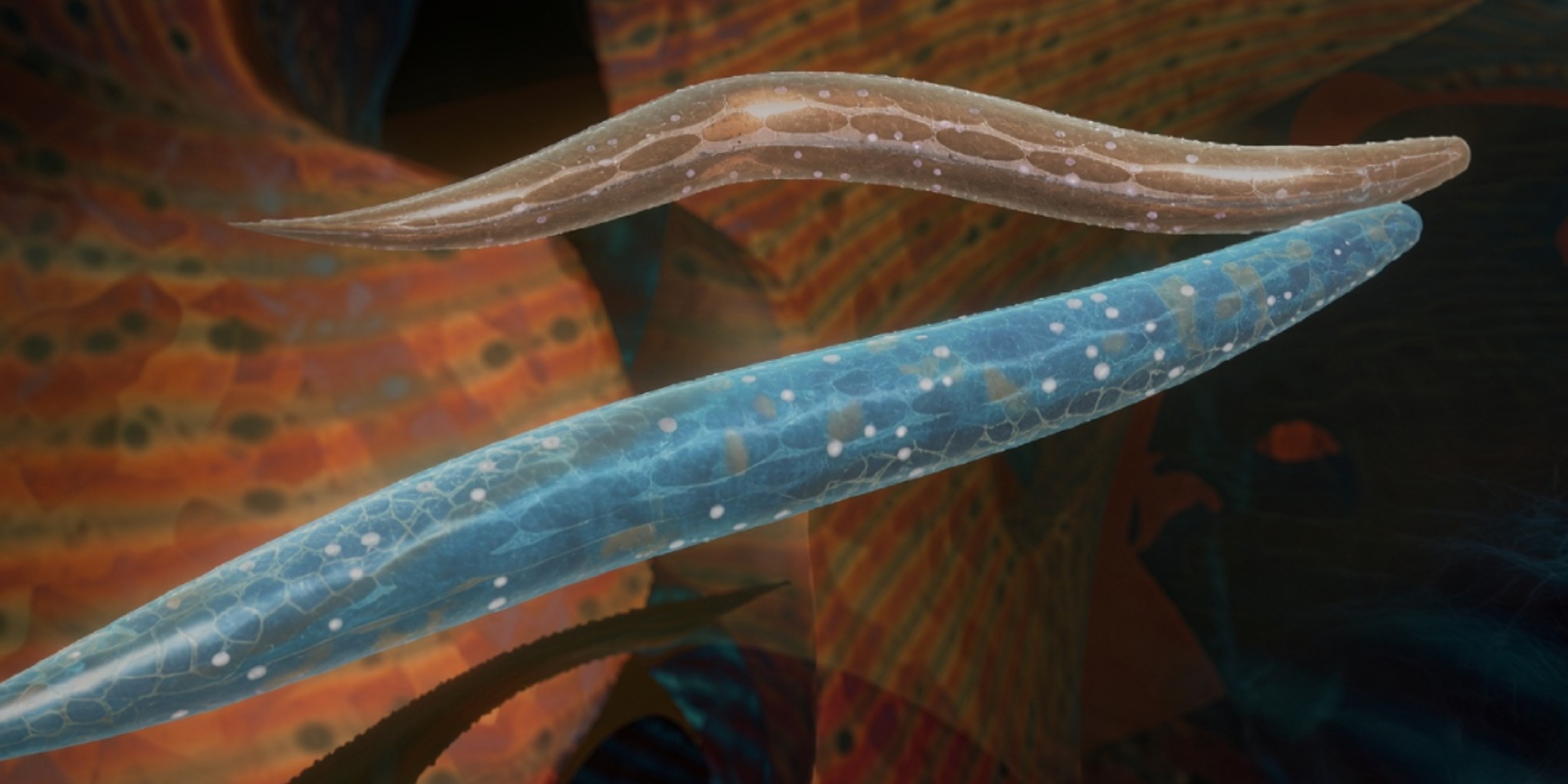
N Ǝ M Ʌ T O D E V.2 is an evolutionary rewrite of V.1. Released as part of the Substrate Transmutation [SETHIX Modules] series on the Ethereum blockchain.
Contract/token: https://etherscan.io/nft/0x71eb648bdd6ebb161dcda890dfadd1d28972ea42/48
Arweave Url: https://arweave.net/aMZW2Mx86Q096gETUq0Ow79Hb0dqUlac6U5fOu3uQSk
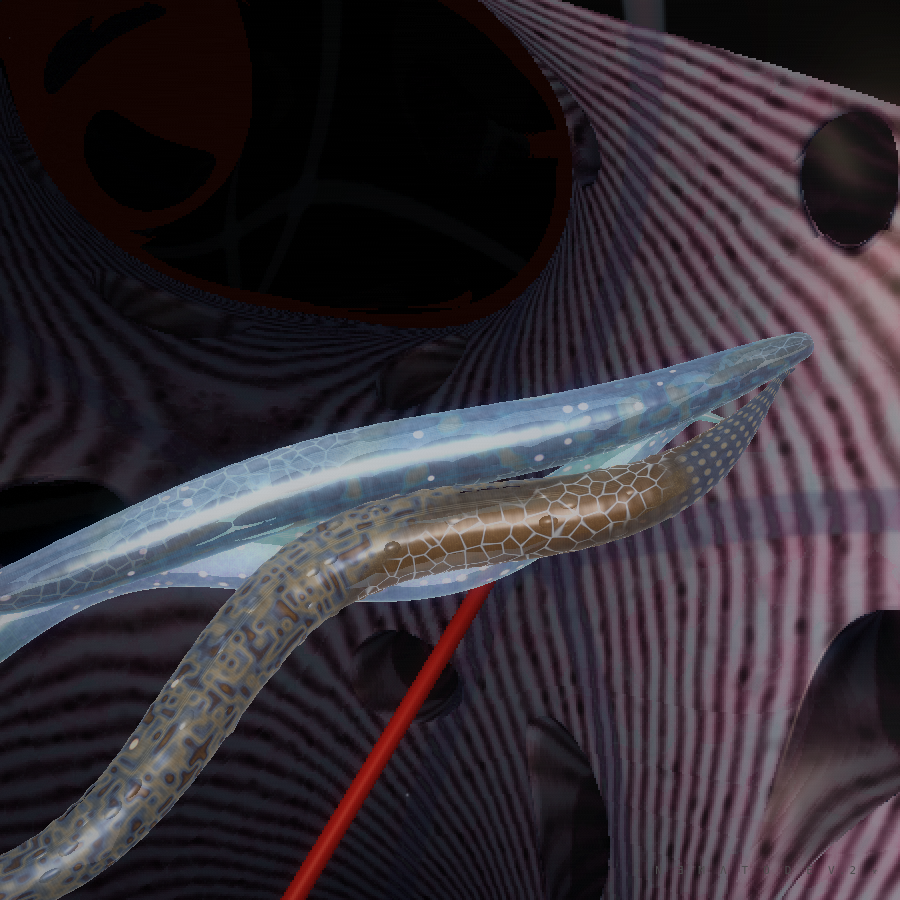
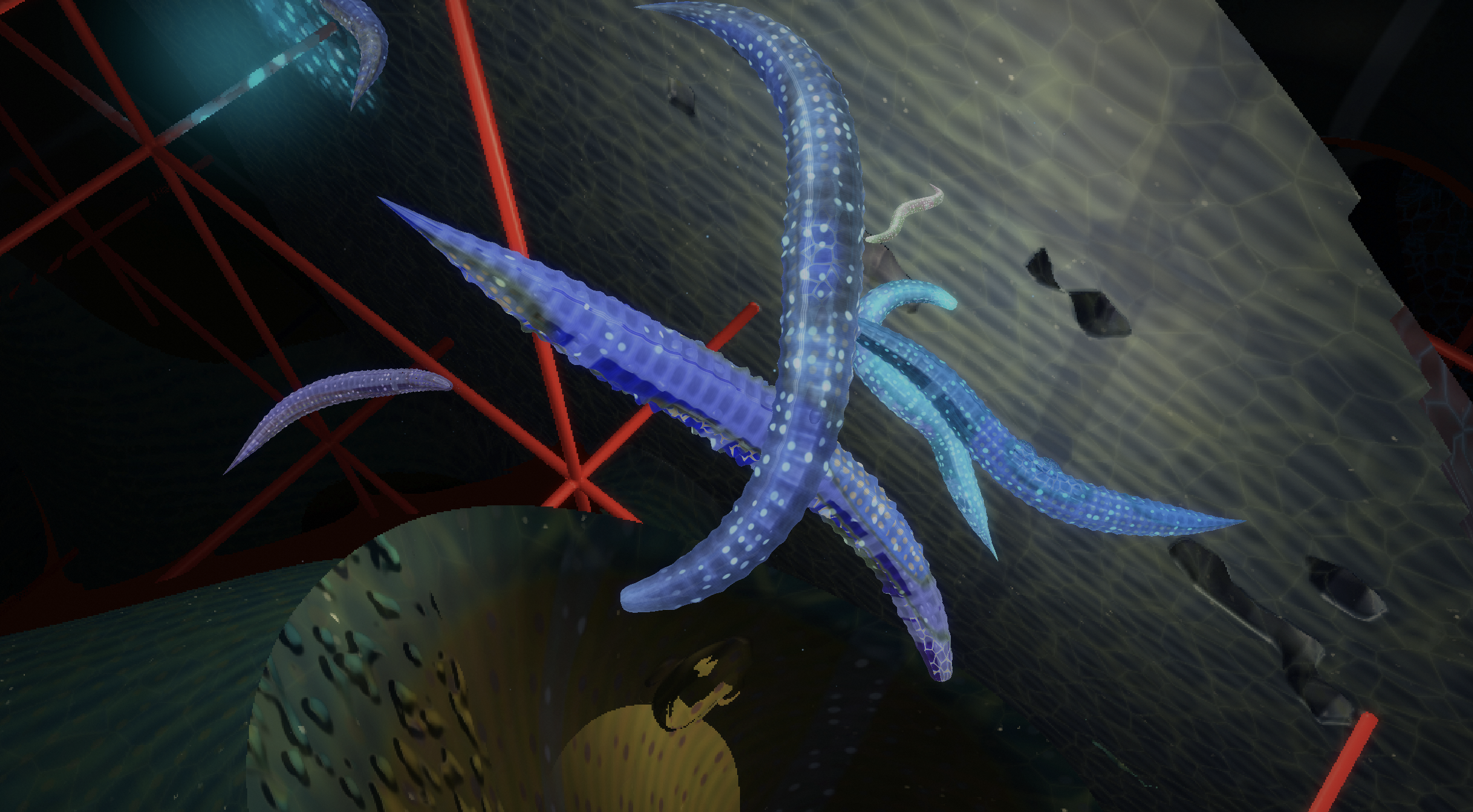
I used a combination of Fable 5.1 and Astra to develop this program, with Grok for prompt engineering. I know that's a bit of a power play, but they all have different strengths and I wanted to push further towards Alife with this project, building on earlier SETHIX modules and what was learned/explored along the way.
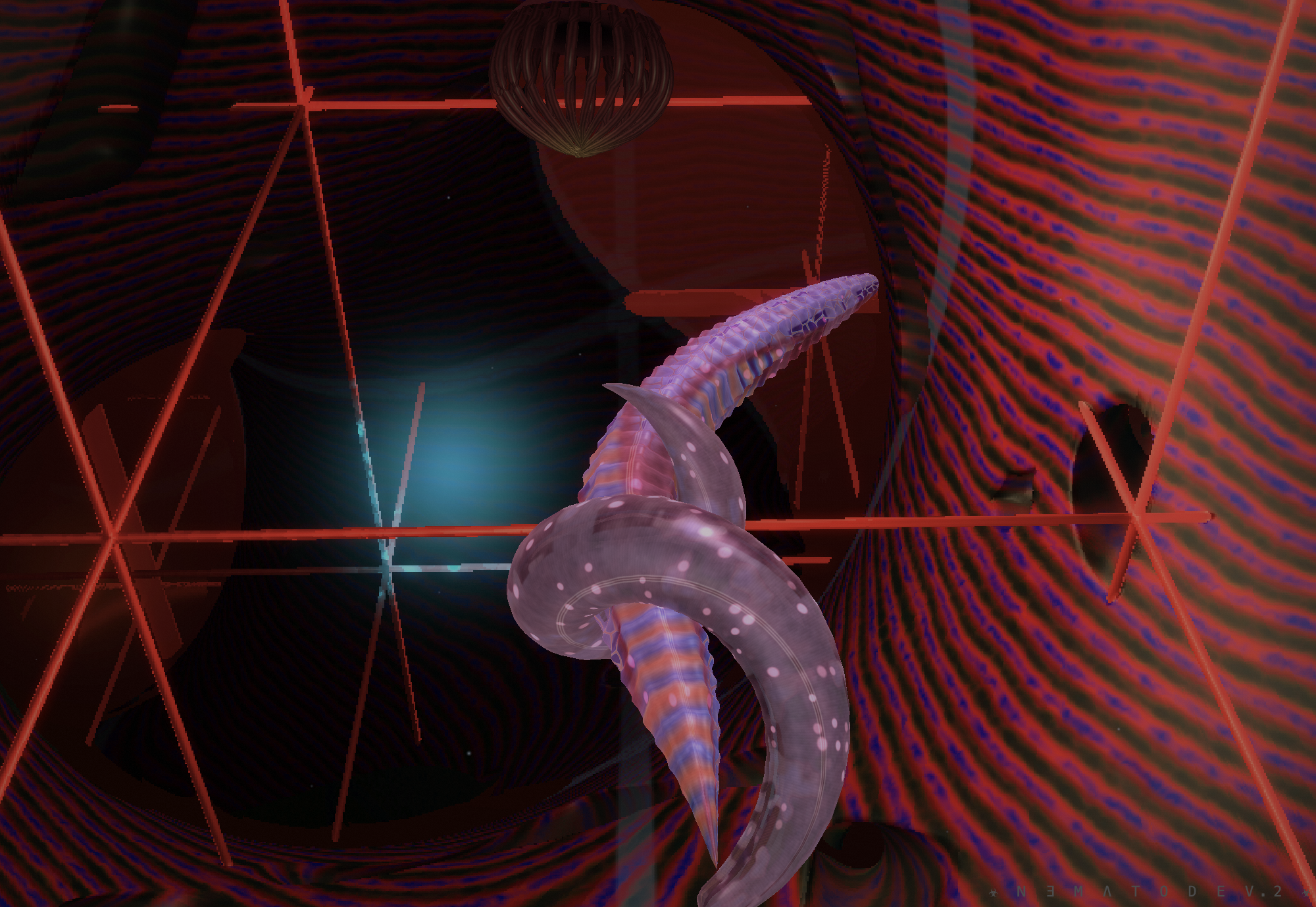
V.2 worms have more complex behaviours. Worms in early development of V.2 and the V.1 worm just bulldozed through the lattice like bulls in a china shops. These worms are more explorative, adaptive, and less robotic that their predecessors. They don’t just constantly tunnel through the substrate as if they they're perpetually hungry. Feeding and exploration is more considered, mating is more of a struggle, or snuggle, and targeted. The result is worms that actually feel alive.
The controls have been removed. During development I initially created a “seek mate” option in the UI but found that non-interference - not disrupting their ecology - actually yields more interesting results. They are more fascinating when observed and not played with. Early versions of V.2 mechanically cycled through infants replacing the adults over multiple generations. Colours and body plans were pretty, but meant nothing, resulting in a colourful generic worm soup. Later patches implemented evolutionary pressures and adaptive responses that give reason for certain colours, patterns, behaviours, and body plans to persist.
Each worm has unique behaviours which it can pass on to its offspring, as well as its mutations. Offspring can also learn new information from their environmental experience through weak epigenetics. Colony continuity is the baseline, but survival is a struggle.
The living host environment responds with protective measures if the worm population grows too big, killing off worms to protect GPU performance.
Interacting with the program - rather than controlling a worm - now means observation and timeline seeding; switch between adults, visit infants and eggs, run the program for days or weeks (or years even) if you like. Track bloodlines, and reload worms that you like or are interested in as new renders to follow their evolution and geneologies across multiple timelines.
The worm population can collapse or multiply to 100s of worms. After forty the living host environment registers infection and begins an immune response. Anticipated GPU lag also tiggers pruning sweeps (wormicide,) so depending on your setup, or if you're running the program in a floating window whilst doing other work, this effects the health of the colony. When the system registers strain on the GPU, it begins releasing deadly spores, producing anemone like organs, slime-mold type matts and traps to reduce the parasitic infestation.
Survival pressure is intended to force adaptation. Earlier overnight renders resulted in over 100 worms. The result felt cheap. Loading the program doesn't guarantee eggs and colony continuity, so when the worms successfully produce eggs and infants, and the host begins attacking, you feel the suspense.
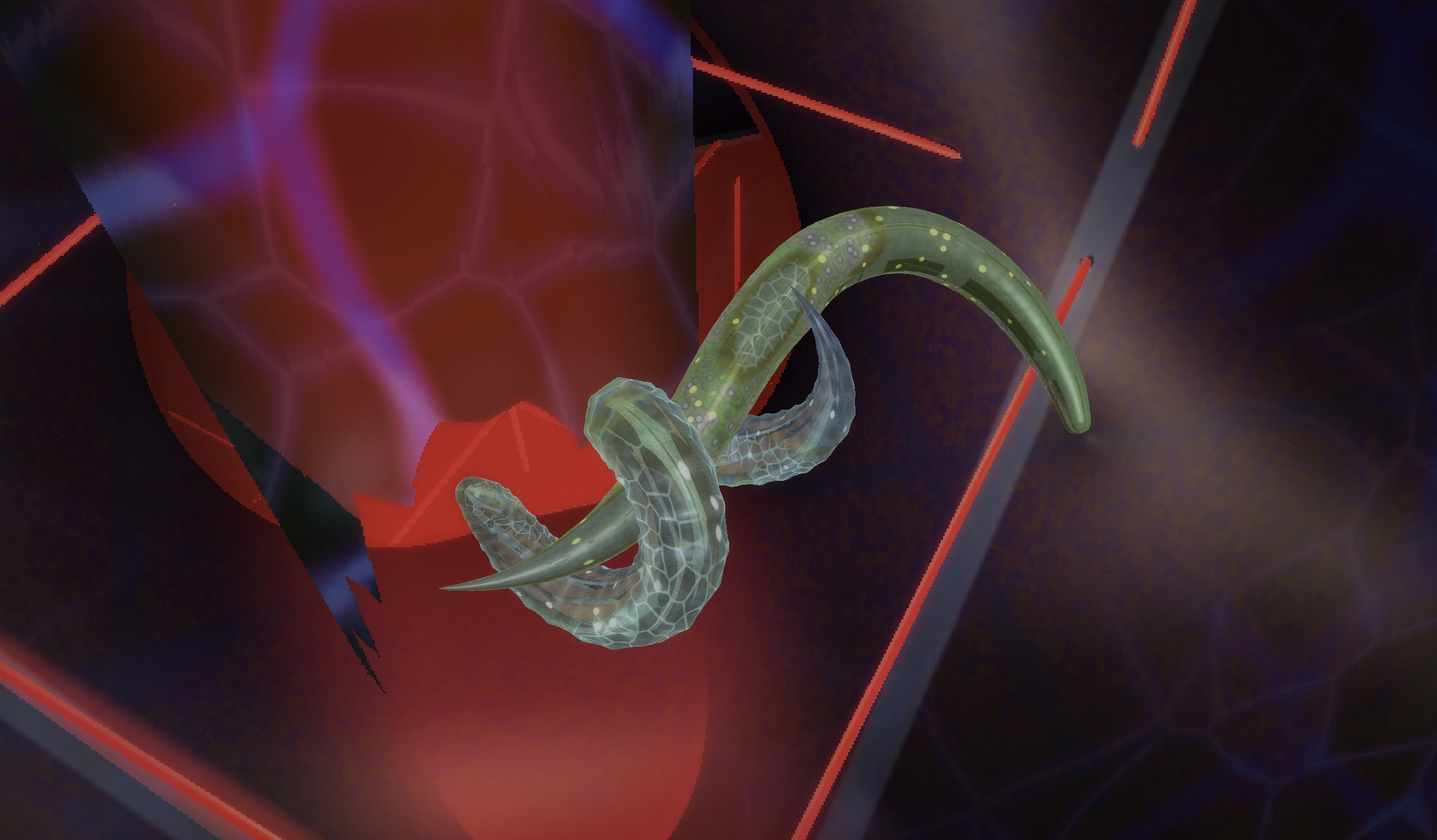
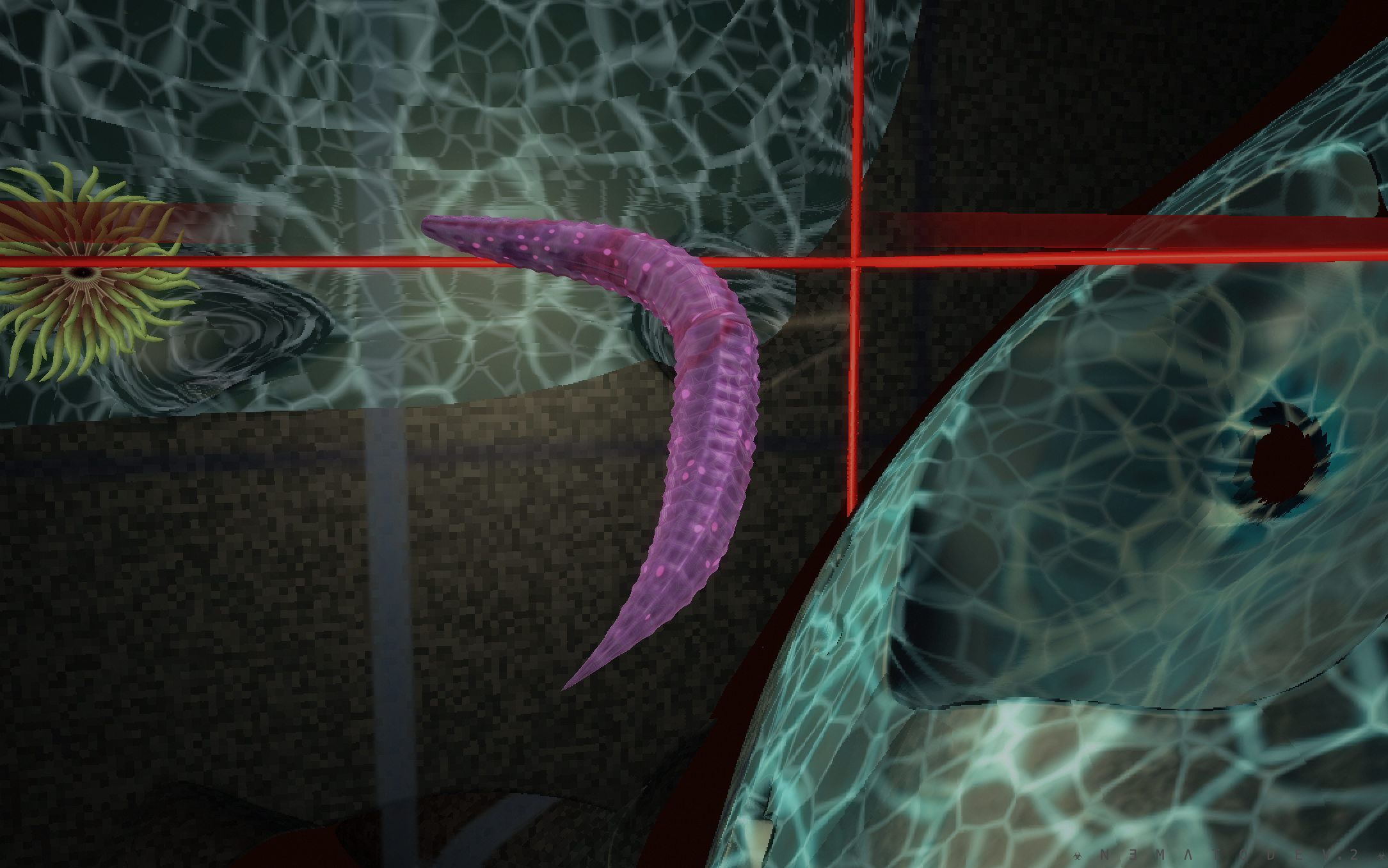
I've compiled an LLM generated spec on ☣︎ N Ǝ M Ʌ T O D E ☣︎ V.2 below:
NEMATODE V.2 System Specification
NEMATODE V.2 is a self-contained WebGL2 culture in Iain Ball’s Substrate Transmutation [SETHIX] series. Nematode bodies inhabit a changing mathematical lattice: they move, feed, encounter hazards, mate and produce descendants. The lattice is the host. The worms are its infection. The viewer follows their lives through the camera.
The work takes an individual body simulation and places it among founders and descendants. Diet changes appearance and constitution. Inheritance carries portions of those changes into the next generation. Temperament and adaptation genes influence how animals feed, reach partners and withstand the host’s local defences. Population growth can provoke stronger resistance from the environment, including on a machine that is rendering comfortably.
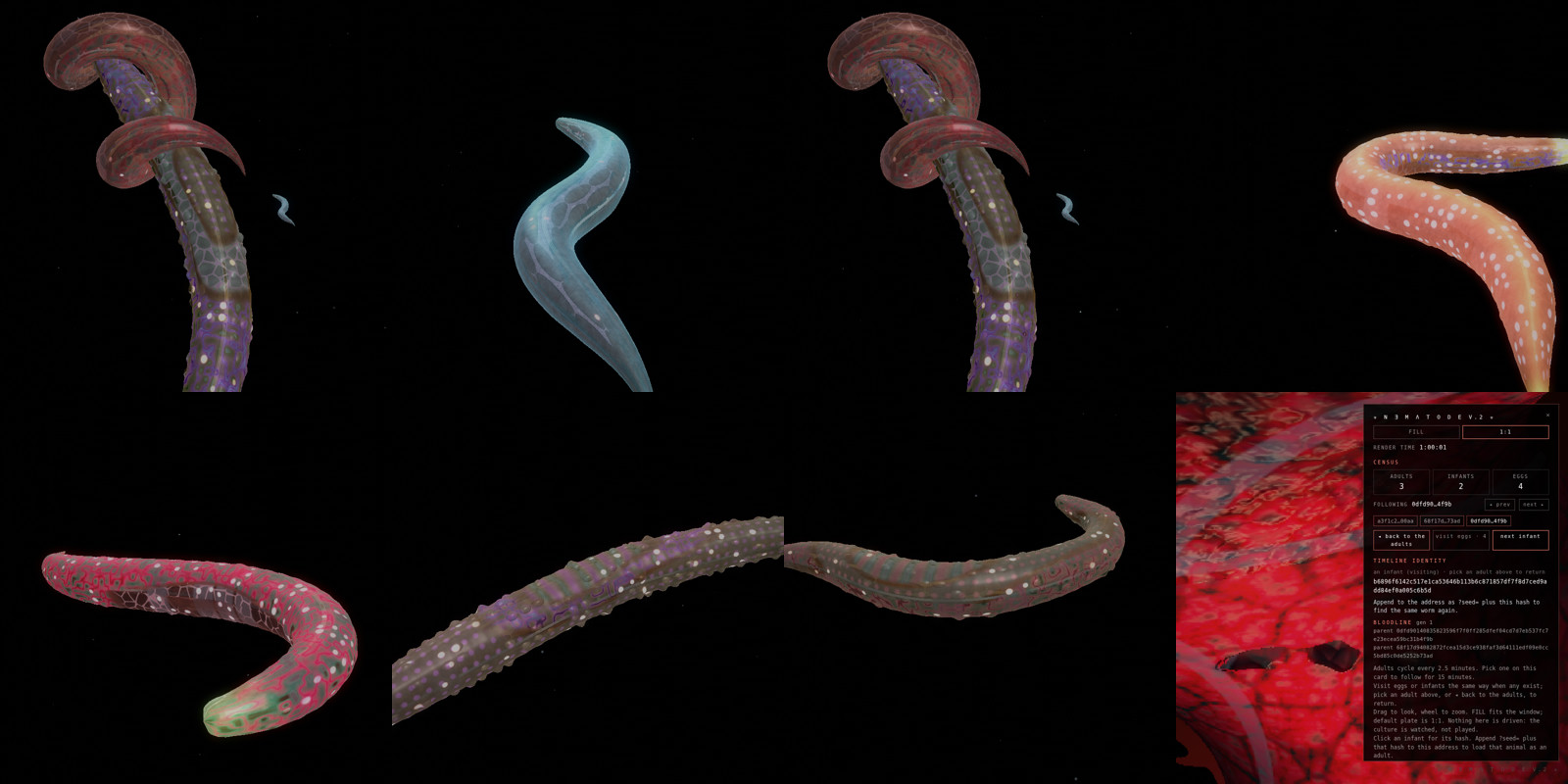
At low population, the culture also has a recovery response. When three or fewer adults and infants remain, eligible, sufficiently fed adults become more persistent about finding and mating with suitable partners. They can seek another pore or work through edible substrate when a passage is obstructed. Recovery through pairing still requires living animals to feed, reach one another, complete a clasp and afford their eggs. A final safeguard applies when exactly one adult remains with no eggs or infants: a mature, sufficiently fed animal already recorded as hermaphrodite may self-fertilise and attempt up to eight energy-paid eggs. A male or an animal with no assigned hermaphrodite role cannot use this safeguard.
Reaching forty living adults and infants triggers an additional infection alarm in the host. Recognition persists after the count falls below forty and gradually subsides. This is a response threshold, not a population ceiling. The build has no separate eight-adult limit and can accommodate more than a hundred worms. Its shared storage can grow from sixteen to 256 slots, and at most eight laid eggs can exist at once. Eggs and uncleared dead bodies share those slots with living animals. When capacity or maternal energy prevents laying, the attempted egg is not created; existing worms are not deleted to make room.
Form and viewing
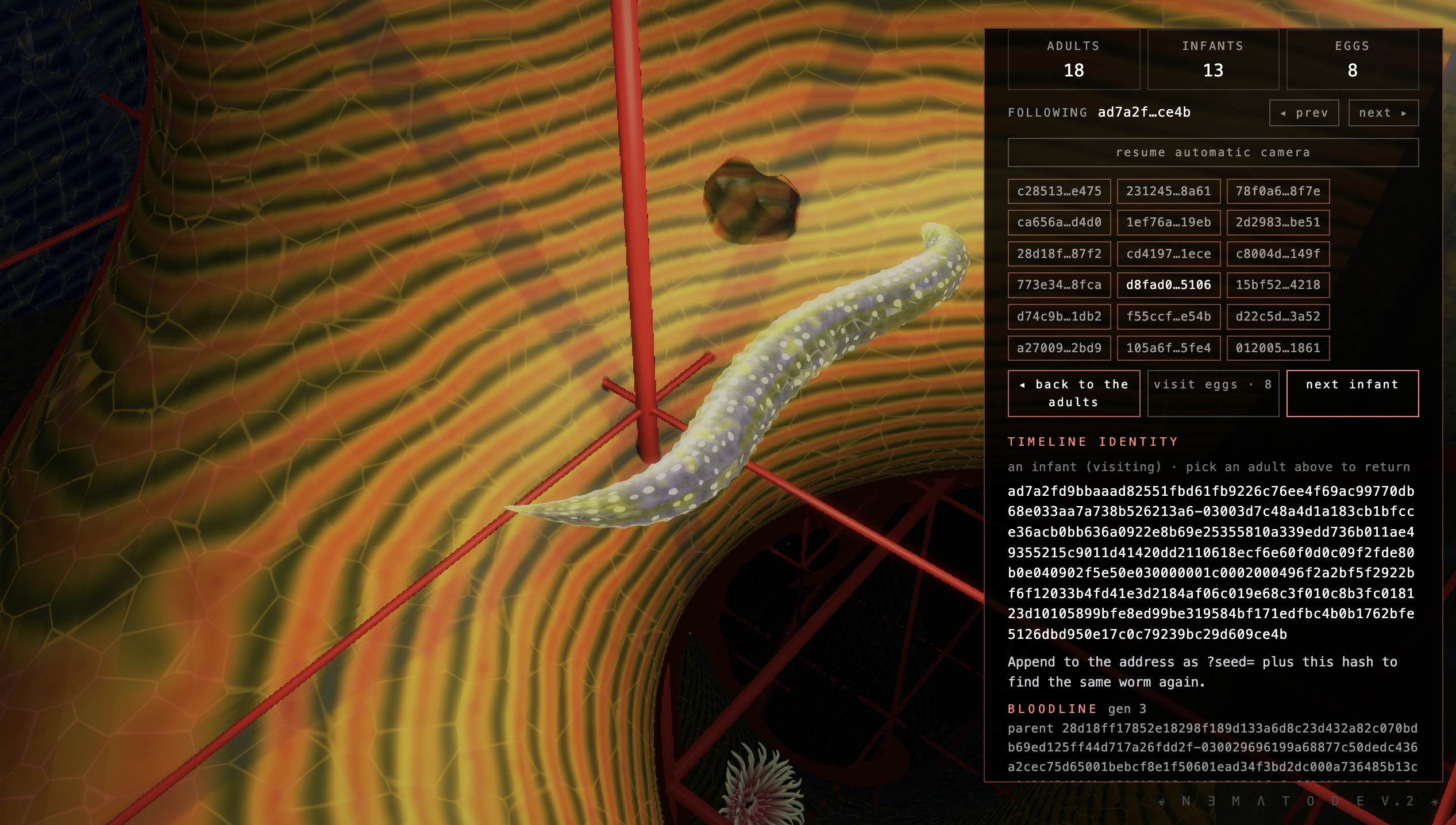
The whole work is one HTML file. Code, wiring data, shaders and procedural graphics use no external libraries or downloaded assets. The renderer combines a sphere-traced lattice with animal bodies and local host organs.
Direct browser viewing opens in Fill; an iframe defaults to a centred 1:1 square. The card can switch between them. WebXR provides an immersive viewpoint where the browser and device support it. The file controls its own presentation; a marketplace’s layout and square preview image are separate.
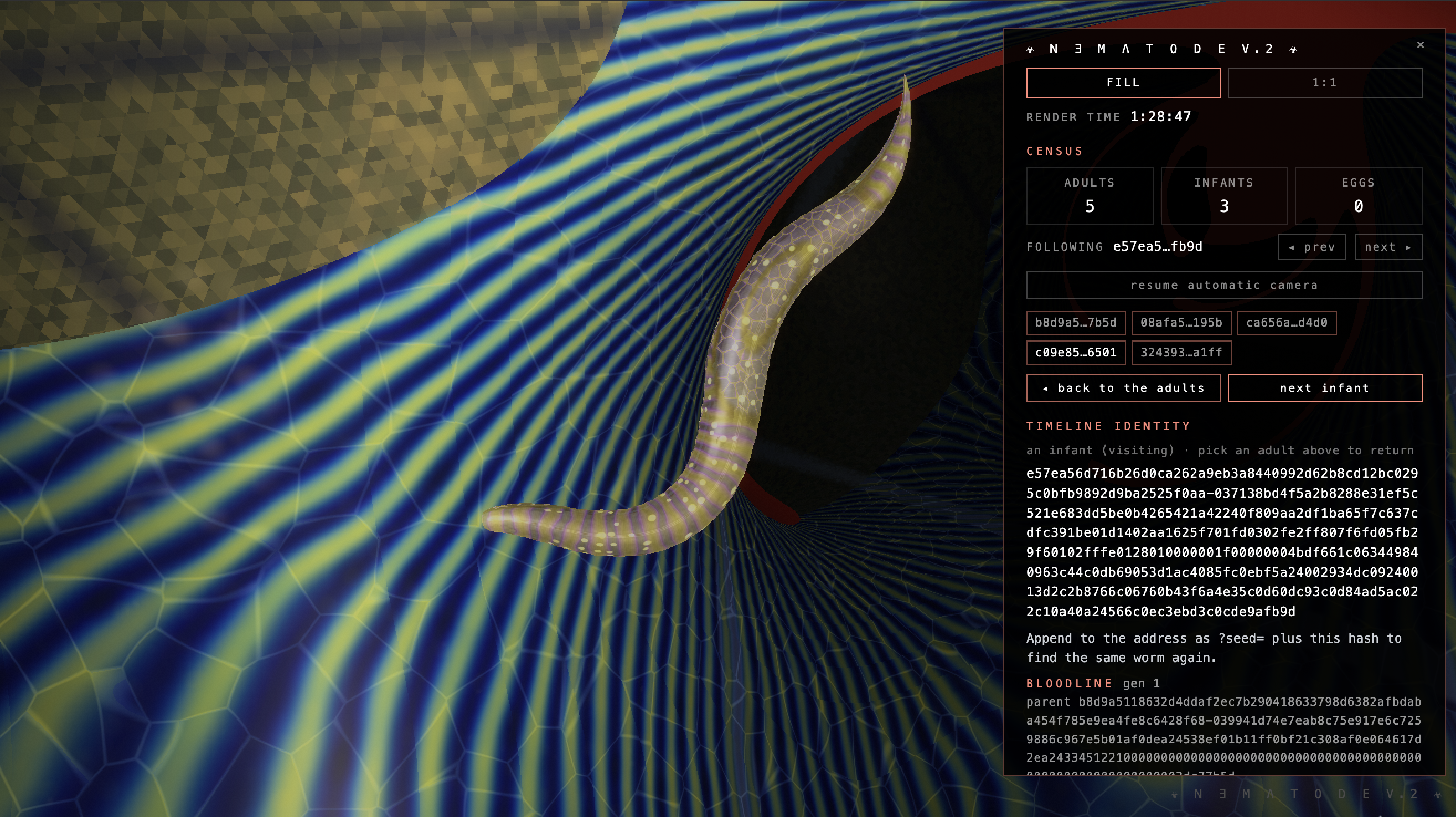
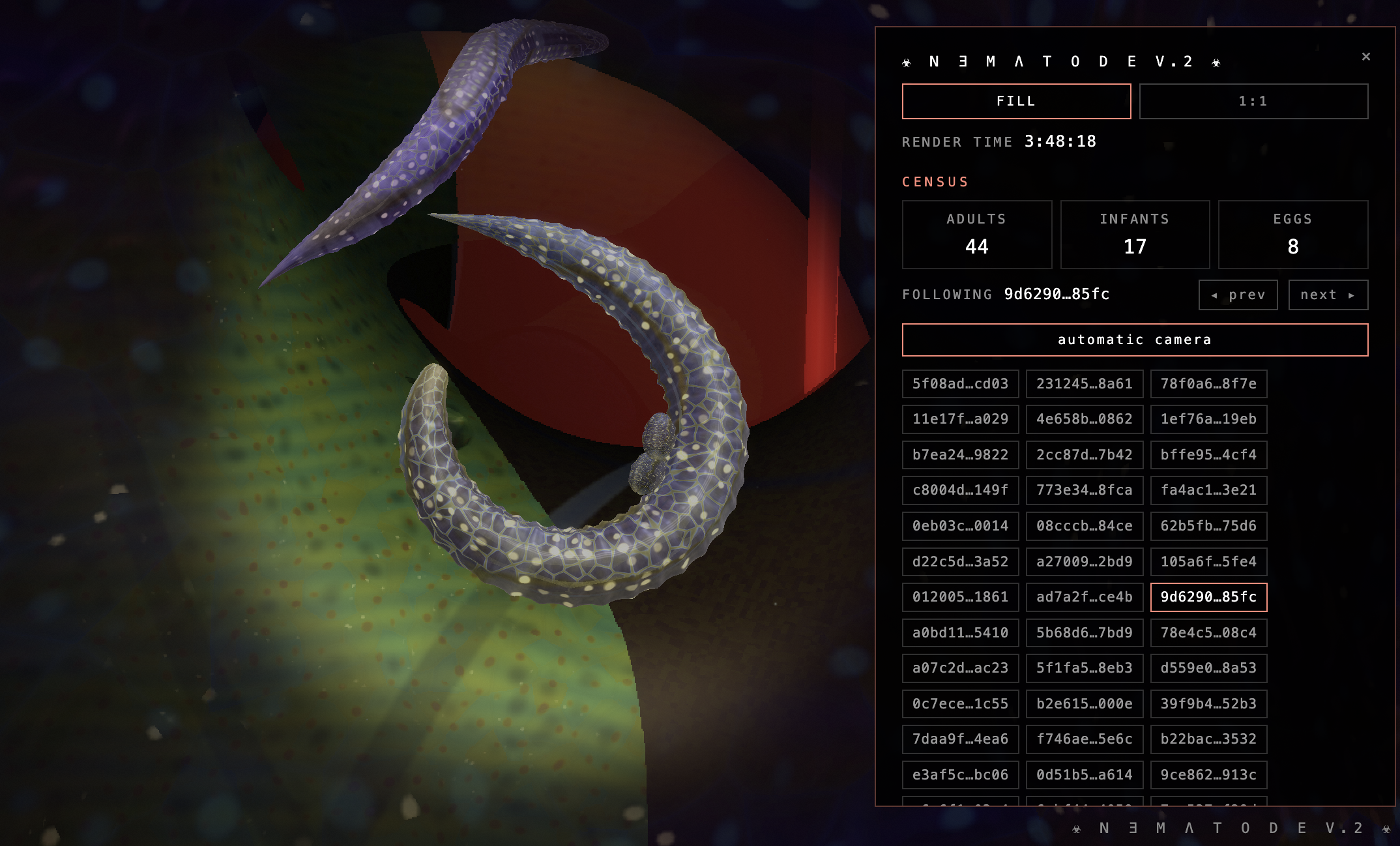
The file is titled ☣ N Ǝ M Ʌ T O D E V.2 ☣. Inspection and testing go through window.SETHIX. Ordinary controls choose a viewpoint: drag to orbit, zoom, select an adult, or visit an egg or infant. The card holds the census, render clock, identities and bloodlines. Console helpers can stage tests and alter the simulation. The normal viewing interface does not drive the animals.
The body model credits Boyle, Berri and Cohen for rod mechanics; Boyle and Cohen for muscle actuators; Cook and OpenWorm/c302 for wiring; Virtual Worm and WormAtlas for anatomy; and Wen and Fouad for proprioceptive coupling. These are the file’s declared sources. The implementation is a reduced, custom model inspired by C. elegans, with a locomotor circuit and simplified body mechanics. Colony ecology, inheritance and host response are artistic computational constructions, rather than a complete biological reconstruction.
How it differs from the first NEMATODE
NEMATODE V.1 centred on one OpenWorm-derived animal in the Nodal Morph lattice and let diet rewrite that body. The viewer could steer its head; left alone, it returned to its own search. A timeline hash supplied its starting identity. What it ate, slowly, became it.
V.2 retains that central relationship between body and substrate, then makes the plate a culture.
First NEMATODE | NEMATODE V.2 | |
|---|---|---|
Cast | One animal | A seeded adult and two founders, followed by descendants |
Viewer | Can steer the head | Follows and visits animals |
Space | One living cage | Four rooms, septa and pores, with material that can be tunnelled |
Reproduction | No colony breeding | Completed pairs, clutches, hatching and growth; emergency self-fertilisation by an eligible lone hermaphrodite |
Identity | Timeline identity for an individual life | Packed birth information and a bloodline record |
Host | An environment the animal eats | Local defences, with additional infection recognition from forty living worms |
Population | One body | Variable population within 256 shared slots and an eight-egg limit |
Recovery | No colony recovery mechanism | Stronger courtship at critical numbers; a lone recorded hermaphrodite can self-fertilise when no eggs or infants remain |
Evolution | Development through the experience of one life | Inheritance and differential survival and reproduction across lives |
World
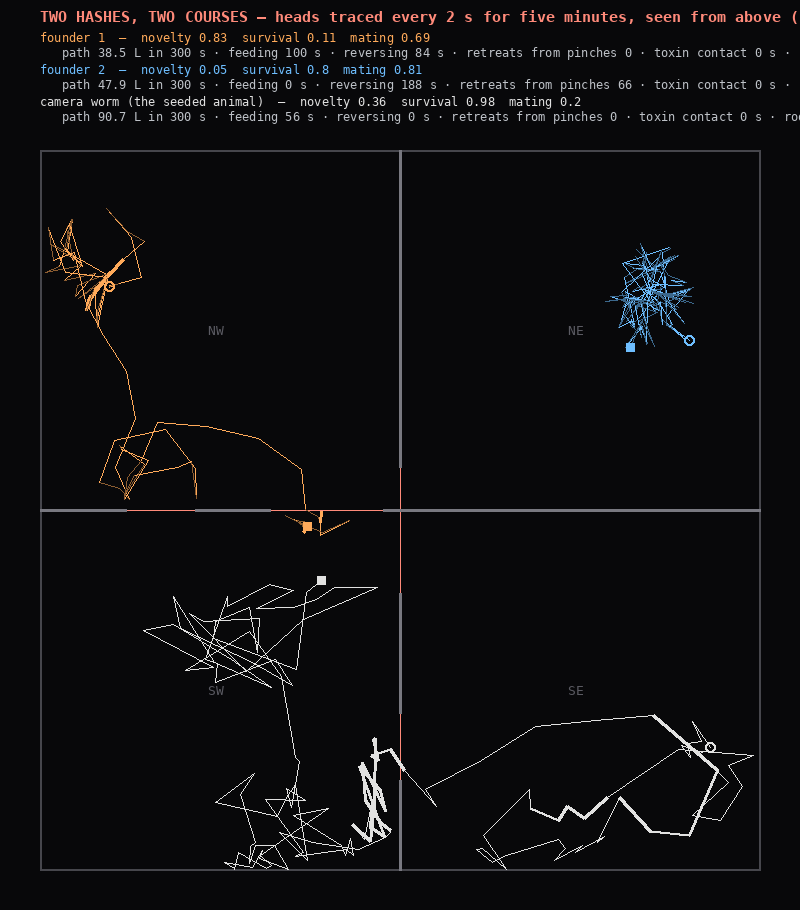
The default arena is three lattice cells along each axis. A cell is 3.2 adult body lengths, making the cage 9.6 body lengths across. Two soft septa divide it into four rooms, each septum with three seeded pores.
Rooms differ in palette, dominant surface patterns, tissue scale, thickness and hardness offsets, and bacterial mix. Their baseline toxic-bloom weights range from 10% to 42%. A varying term also affects individual blooms, so these are model weights, not fixed observed proportions.
The field moves through a Fourier morphospace associated with Nodal Morph. Dwell, wander, transit and chirality changes alter the substrate. Geometric gates and a surface-speed governor constrain the drift. The current default morph-rate multiplier is 0.25.
Soft material can be tunnelled, and passages can close again. Existing pores guide travel between rooms, but they are not the only possible routes through the septa. Hard structures remain obstacles to mate-route chewing.
Worms and observation
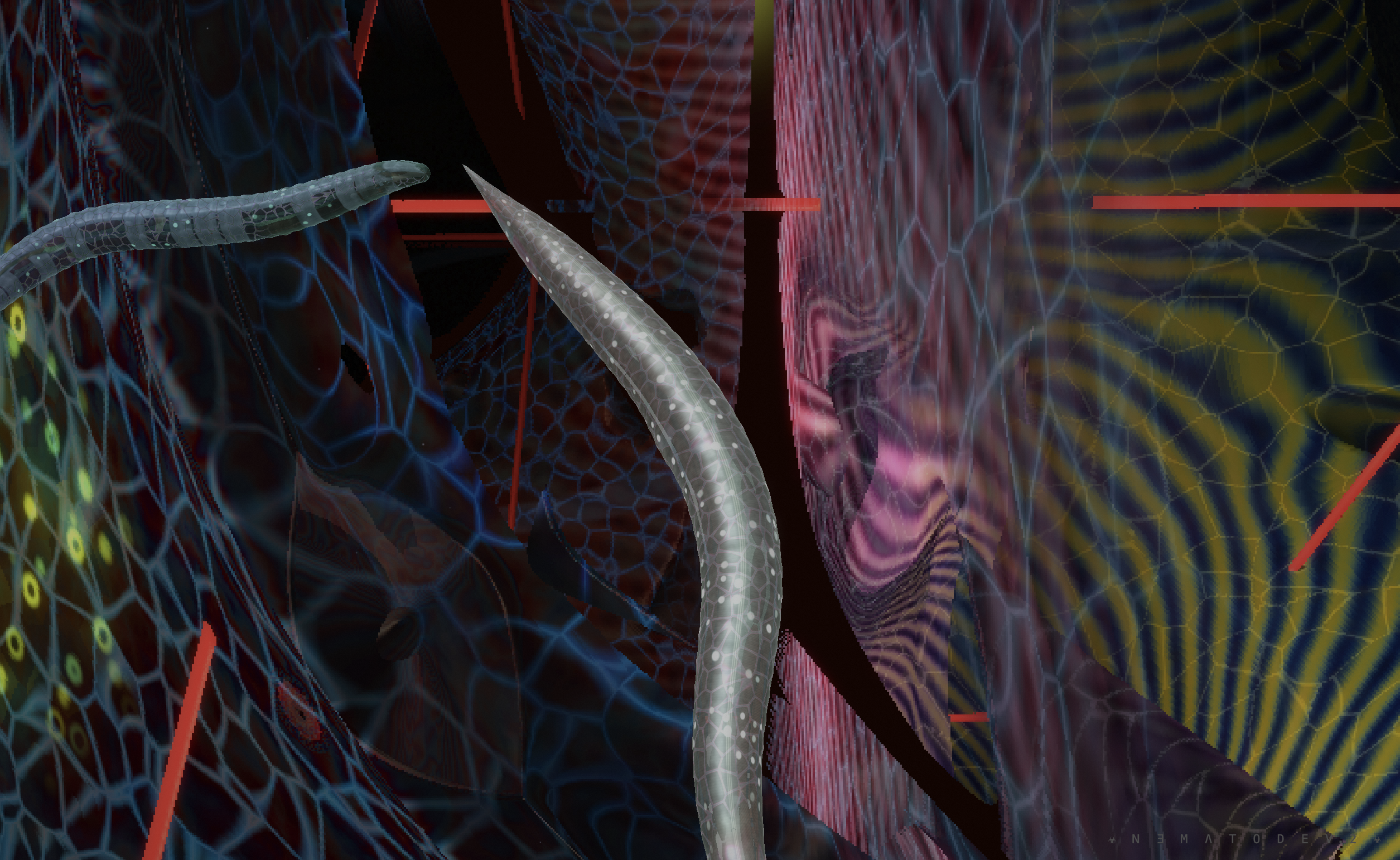
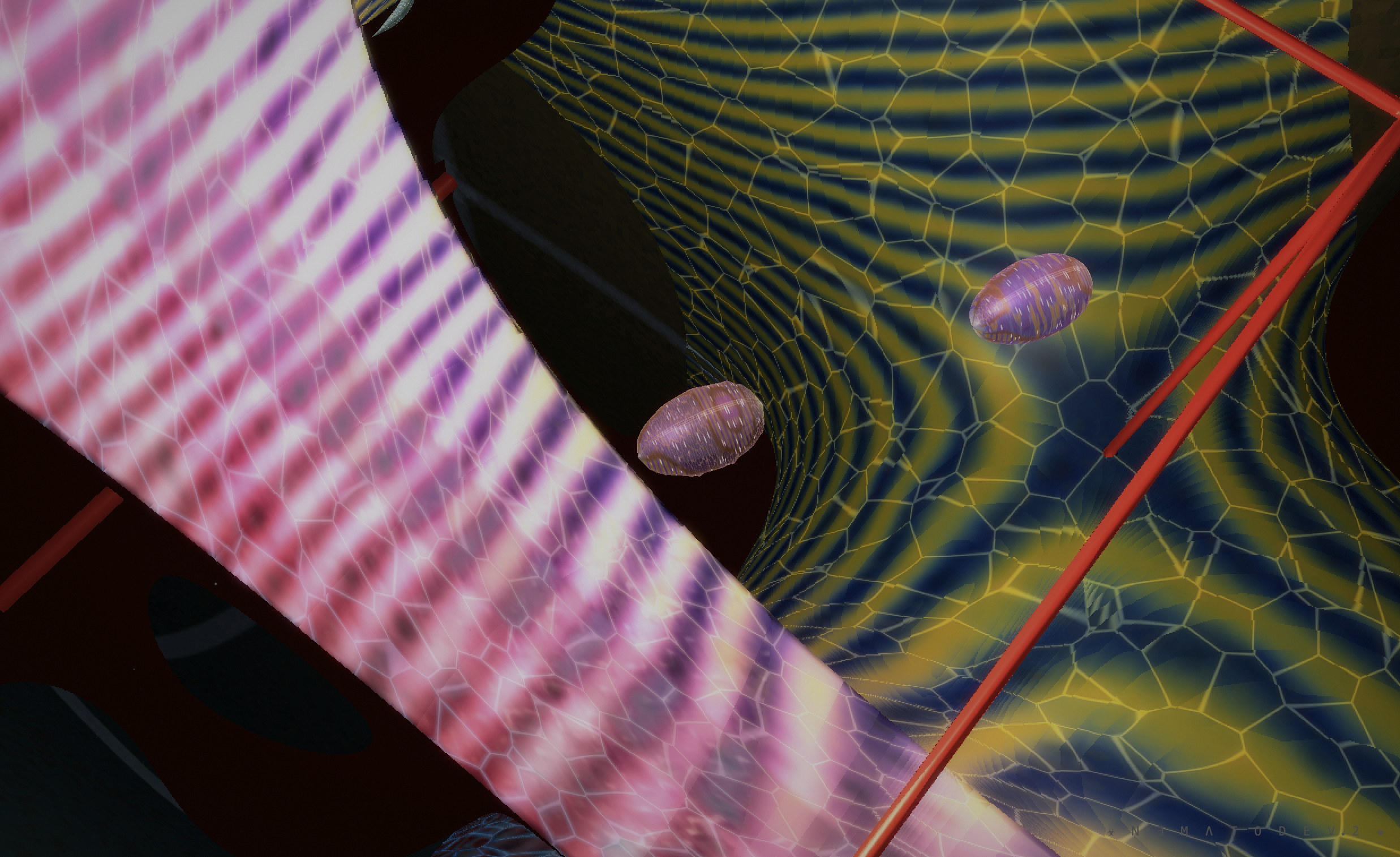
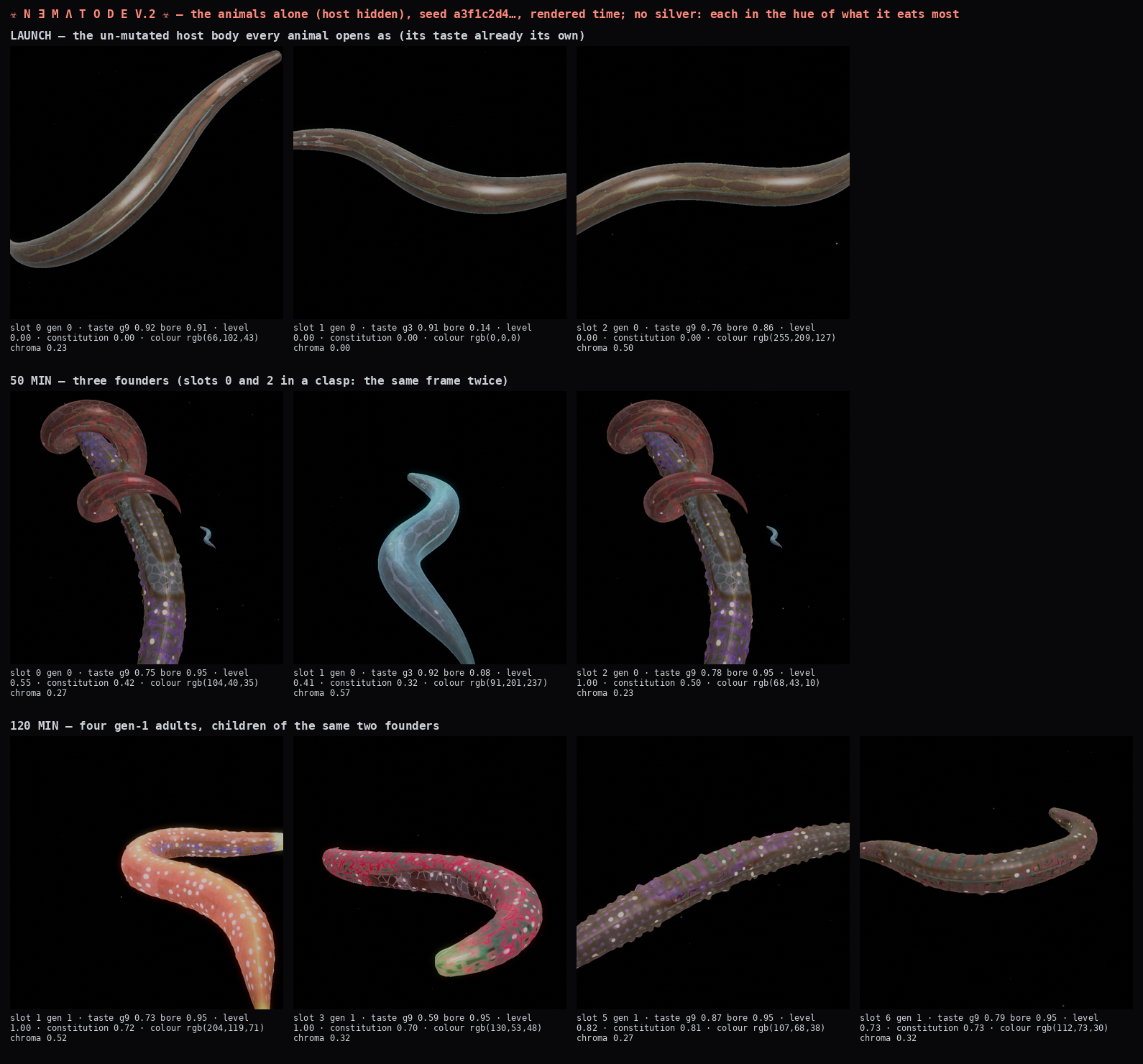
A normal launch creates three adults: the seeded animal and two founders in other rooms. The extra founders begin with no accumulated diet expression, constitution, learned place memory or inherited host marks. Their innate traits already differ. One leans toward novelty and boldness, with weaker survival sensing and less preference for cover; the other begins near the opposite pole.
A lead founded from a descendant’s packed identity instead begins with its encoded inherited genome, constitution and ecological information. It starts a new adult life and must still meet that life’s feeding and maturity requirements.
One adult at a time uses the detailed rod-body and nervous-system simulation: 48 segments, 49 rods and a one-millimetre reference length. The embedded locomotor graph has 137 named neurons. The muscle model has 95 active body-wall positions in four quadrants. Curvature feedback, command signals, oscillators and graded relays drive muscle activation.
Other animals use cheaper 49-joint track motors. They still move, feed, change expression, learn, age and encounter the host while unfollowed. When an adult takes over the detailed body, its diet and ecological state go with it; the previous adult continues on a track motor with its own state. Automatic life-cycle camera visits can observe another animal without transferring the solver. The two motors are different approximations, so changing who is followed can change the subsequent trajectory.
The automatic camera generally tours adults every two and a half minutes of its camera clock, with selected mating, laying and hatching visits. Cooldowns limit event switching. A manual choice stays with that identity while it lives, until the viewer changes selection or resumes the automatic camera. A visit can remain with an identity as an egg hatches and the infant grows. In a crowded culture, the camera selects events rather than showing every birth or clasp.
Behaviours
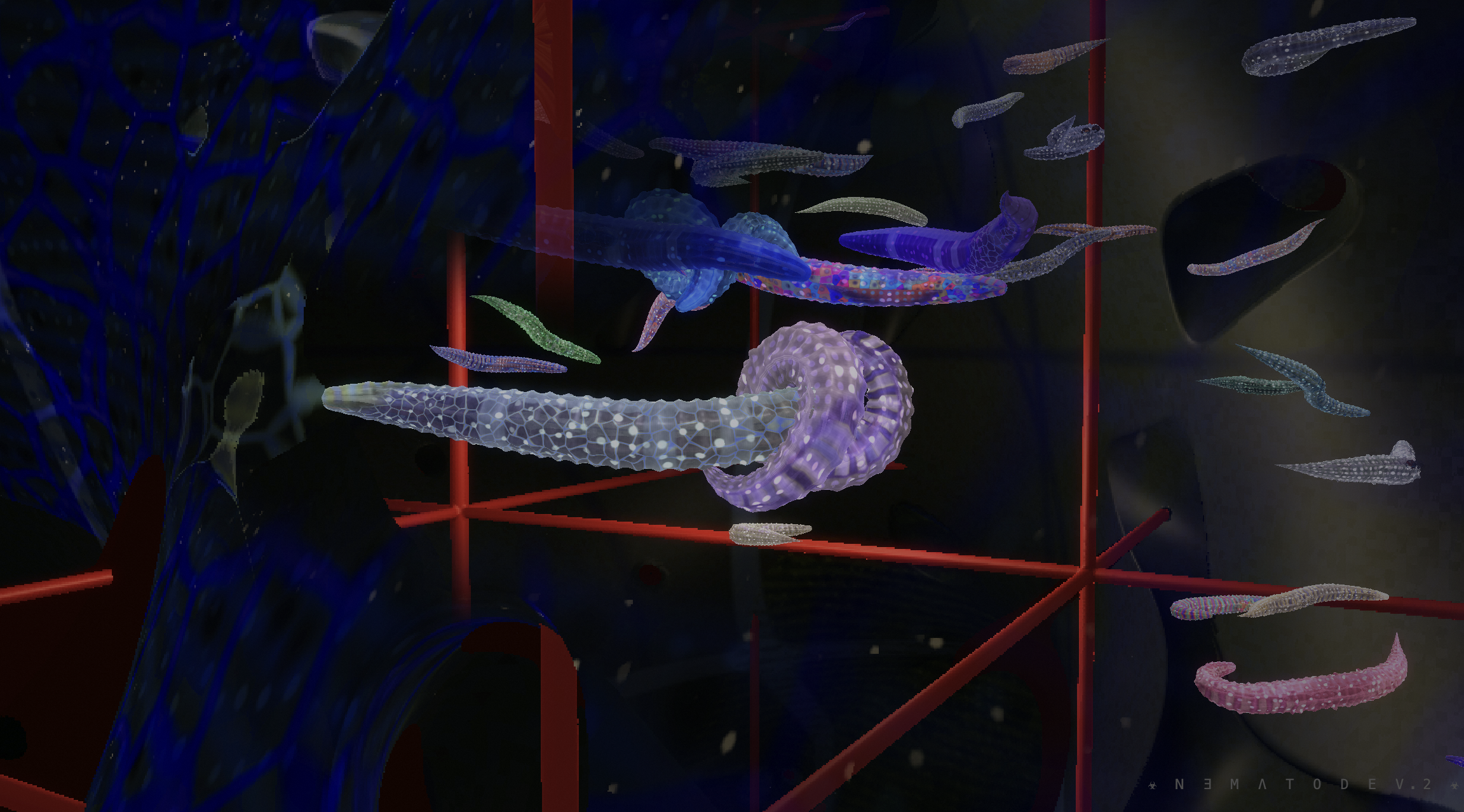
Movement combines local sensing, behavioural rules, learned biases and temperament. Animals search, approach food, feed, reverse, turn, seek partners and struggle against obstruction.
Reaching a mate
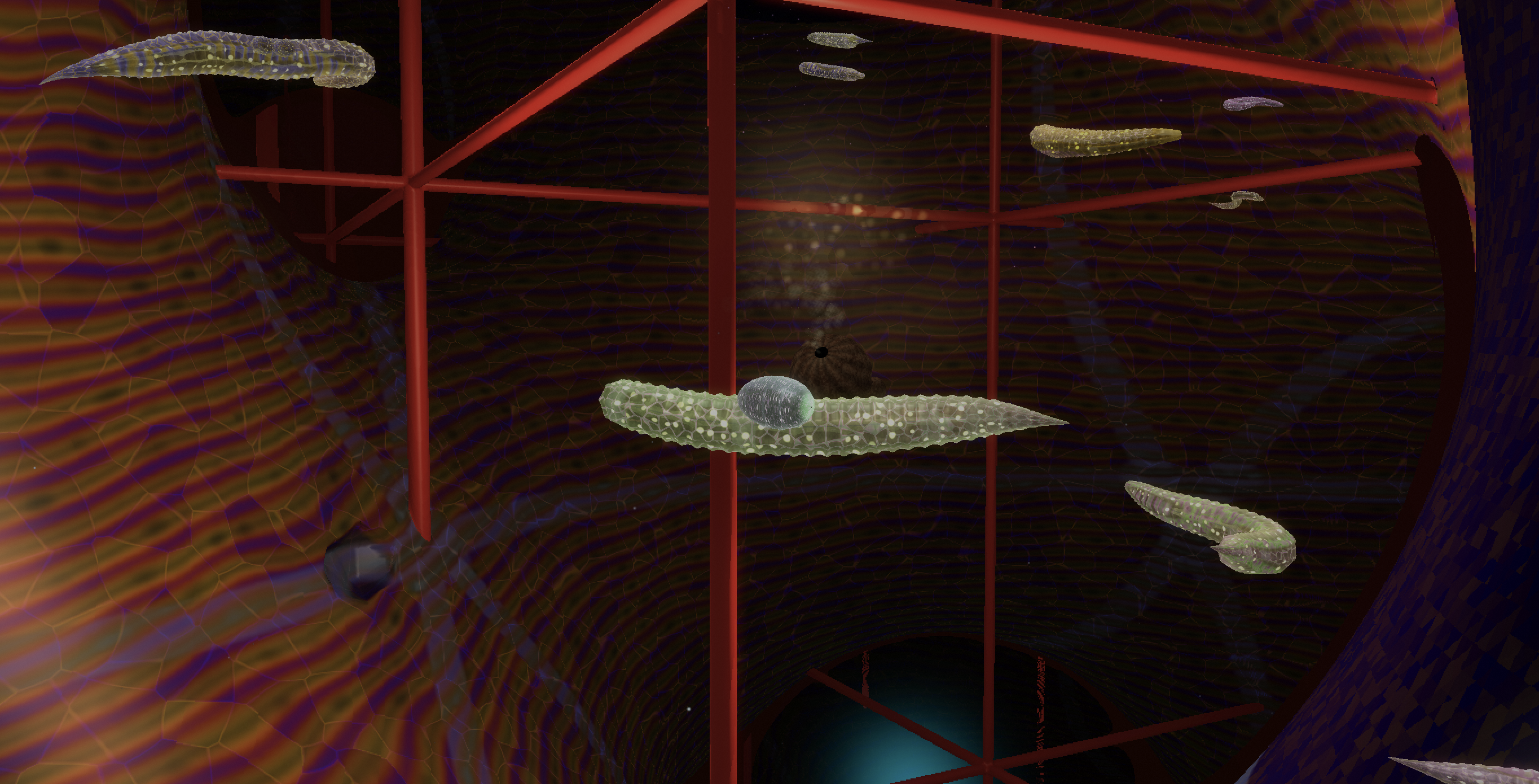
Mate seeking uses a coarse local grid and routing toward septum pores. Open routes are comparatively cheap. Edible soft tissue can become a more costly route when the seeker has sufficient energy and is not heavily burdened by local load or wounds. Remembered harmful cells add to the route’s cost. If a chosen pore cannot be reached, the seeker can temporarily avoid it and try another.
A planned route does not move the animal. The body must follow its own motor through the geometry. The track motor can chew while seeking a mate as well as while feeding. Forward movement into soft tissue is constrained while the mouth works. The detailed body also accepts chewable mate waypoints through its existing navigation and chewing system.
Passage-making draws on existing differences in boring taste, boldness, greed and learned feeding preferences. Adequate reserves permit the work; effort costs energy, and actual material eaten can replenish it. A depleted animal loses the extra recovery drive and gives feeding greater priority before attempting another approach.
The advantage is therefore conditional: a fed, persistent borer may reach a partner that another animal cannot. It has no guaranteed route through every barrier. Contact responses, carving and limited position corrections help bodies leave obstructions, but infants and adults can still become trapped and die.
Temperament
Seven heritable axes bias existing behaviours. They are blended and mutated at birth, separately from learned experience.
Novelty biases exploration against remaining near familiar resources.
Survival biases toxin recognition, hazard avoidance and retreat from confinement.
Mating influences partner seeking and pairing probability.
Boldness changes avoidance and persistence under threat, contributes to active escape, and helps determine passage-making effort.
Fidelity can retain attraction to a partner or laying location for a limited period, subject to other needs.
Shade biases movement toward the model’s cover and darkness cues.
Brood favours lower-threat, food-favourable nearby locations while a clutch is pending.
Brood does not build a nest, move laid eggs or supply parental care. A parent does not evaluate a laying site by measuring the later survival of its young.
Adaptation and trade-offs
Eighteen adaptation genes influence contrast and colour channels, light, relief, motion, uptake, retention, detoxification, cuticle, greed, maintenance, fecundity, learning, coating, colour matching and bacterial-flora retention. Local expression is reversible. Adaptation genes and regulatory coefficients recombine from parental values with mutation; temperament and the diet vector use their own blending rules.
Advantages depend on the encounter. Colour matching can reduce anemone visibility, while glow trades greater visibility and energy use for chemical protection. Relief and active escape help resist restraint, but escape also costs energy and reduces feeding. Greed increases feeding and raises the energy needed to pair. Maintenance can slow biological ageing when sustained feeding has paid for repair. These interactions give appearance and behaviour consequences for survival, described in Mutations below.
Mutations
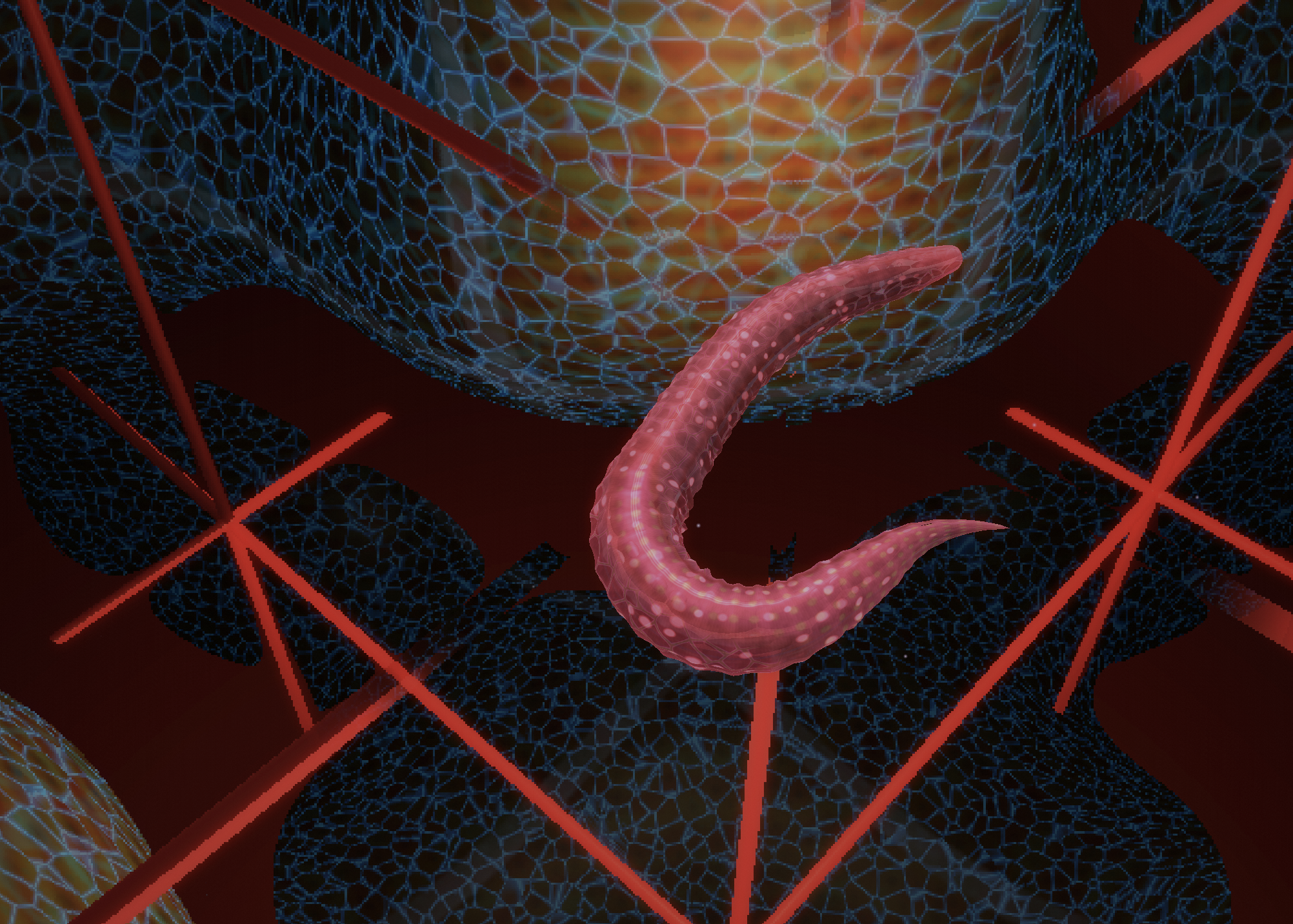
Meals sample local material and bacteria into a short-term diet record. The basic buffer has a 900-second decay timescale, with expression thresholds at 35 and 190 mass units. Expression rises and falls gradually. Sustained expression also builds a longer constitution, using a 4,000-second integration parameter and an 86,400-second decay term. These are model parameters, not exact appointments for a visible change or disappearance.
Diet contributes to colour, surface pattern, puncta, glow and relief. The adaptation layer also adjusts colour, glow, coating, motion and relief in response to the local environment and energy. Appearance therefore combines meals, inherited constitution and current adaptation. A small meal changes internal state even when little shows. Later feeding and changing conditions can keep reshaping the body.
These changes have consequences for survival. Eighteen inherited adaptation genes influence how a worm expresses its body, processes food, withstands exposure and pays for maintenance. Their effects interact with temperament, learned responses and the particular hazards encountered. No single appearance is best everywhere.
Glow offers chemical protection at a cost. In this model, stronger glow reduces toxin uptake from harmful blooms and contributes to protection against chemical exposure from spores and slime. The latter protection varies with local chemistry and becomes stronger in darker conditions. Glow also consumes energy and increases visibility to anemones. It does not directly prevent slime or traps from gripping the body. A bright worm can therefore withstand chemical exposure better while attracting more anemone strikes.
Colour matching offers another route through the host. Stronger matching brings local colour expression toward the room’s chemistry more quickly, while slowing its response toward food-bloom tint. Reduced colour mismatch can lower anemone visibility, particularly during movement. Darkness further reduces the mismatch contribution, but does not cancel the visibility added by glow. Matching is a change in colour expression, not the invention of new camouflage textures.
Diet can support chemical resistance. Bacterial meals build flora. Flora works with detoxification traits to reduce chemical load and toxin uptake; inherited gut-flora retention affects how long that benefit persists between meals. Coating also provides chemical protection and carries an energy cost. These advantages depend on the body’s condition and feeding history. Resistance can diminish when meals stop, and a hungry or insufficiently defended worm can still accumulate a lethal burden.
Relief and movement affect physical escape. Expressed relief helps resist accumulated grip, while cuticle and active escape traits also contribute. Boldness and motion influence how strongly an animal struggles against contact. Active escape can reduce anemone strike probability and help a body resist restraint, but it consumes energy and interrupts feeding. Movement can also make a mismatched body more conspicuous. Remaining still and wriggling free each carry different risks.
Feeding and reproduction introduce further trade-offs. Greater feeding drive can increase intake and willingness to exploit risky food. Fecundity influences clutch size, but eggs require energy, and higher fecundity also raises the cost per egg slightly. Maintenance can support repair and slower biological ageing when feeding pays for it. A well-defended animal that cannot obtain food or reproduce may survive an encounter without sustaining a lineage.
The trait space remains defined by the program. The connectome does not evolve, and generations do not unlock new skills or behavioural states. Within a life, feeding, reversible expression, injury and learning produce development; the inherited adaptation genes themselves remain fixed. Across lives, recombination and mutation create different starting combinations. Faded parental host marks can also carry a small residue of diet and exposure into offspring.
Selection arises when these differences affect survival and reproduction. A glowing, chemically resistant lineage may fare well around spores or slime, while a less conspicuous lineage may fare better near anemones. Neither outcome is guaranteed: position, movement, food, partners and the changing host continue to matter.
Breeding
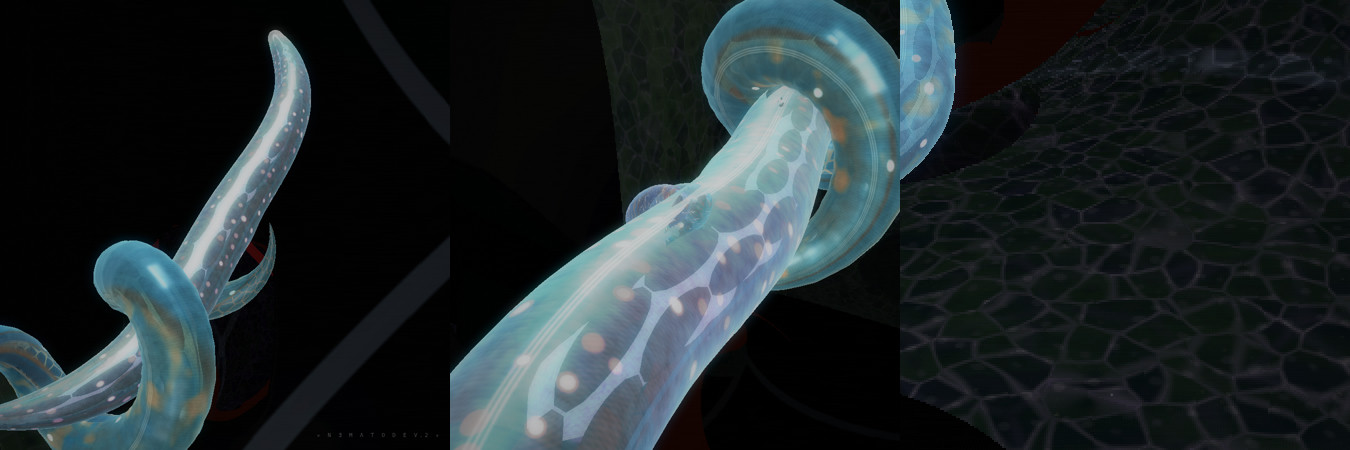
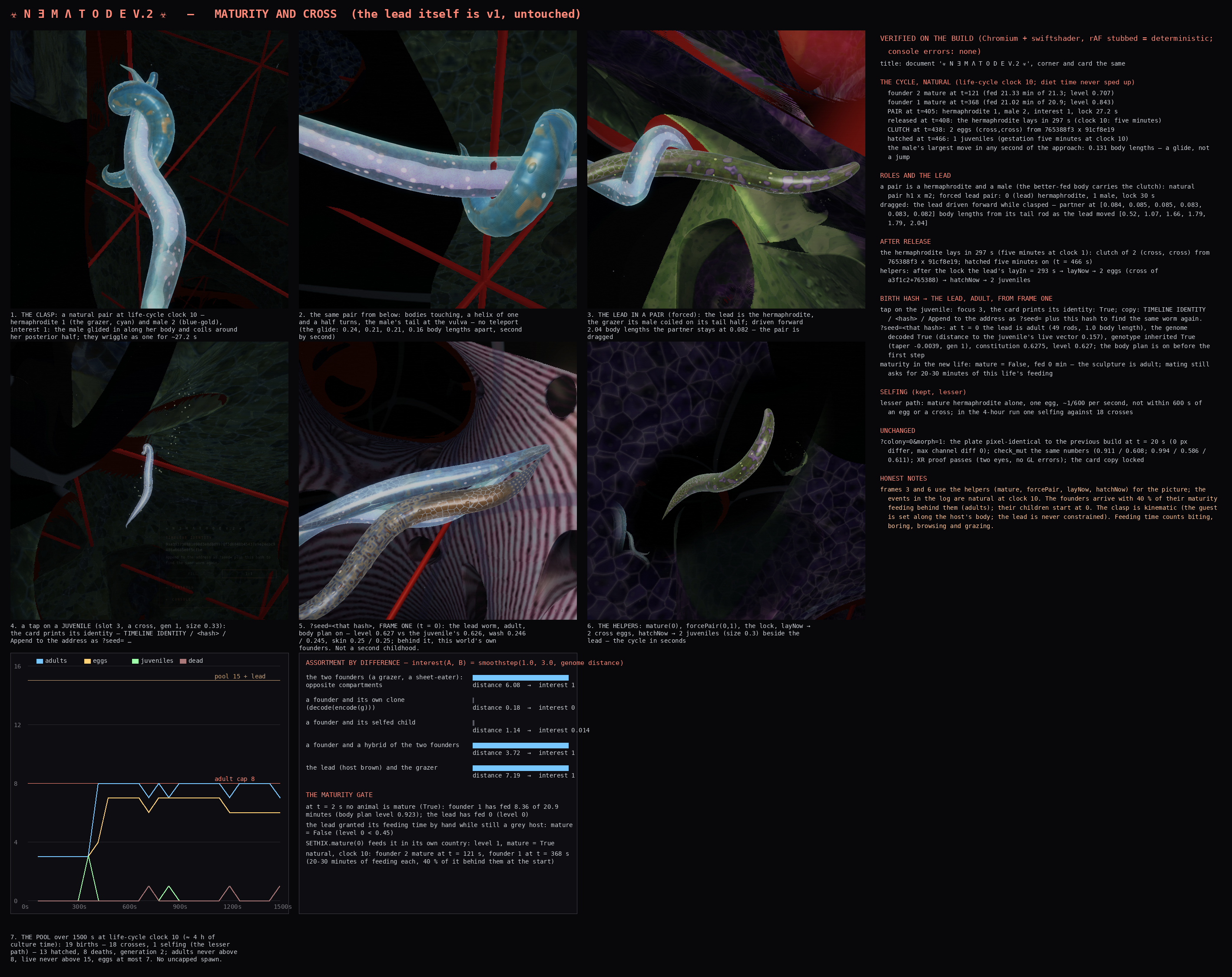
Ordinary reproduction requires a completed pair. Self-fertilisation is restricted to a last-resort recovery condition: exactly one adult remains, there are no eggs or infants, and that adult is a mature, sufficiently fed, recorded hermaphrodite.
Maturity needs at least ten minutes as an adult, four to six accumulated feeding minutes, and diet expression of at least 0.4. Once reached, maturity stays latched. Ordinary pairing also needs sufficient energy and low enough toxin, ecological load and wound levels. Founders receive no feeding-time head start.
Pairing favours difference between diet, constitution and temperament vectors, with a further contribution from adaptation-gene differences. Unlike partners can be preferred. There is no absolute ban on close relatives or similar genomes. Mating temperament changes probabilities; a low value does not categorically prevent reproduction.
Within a pair, the animal with the higher combined diet-expression and food-mass score receives the clutch-bearing role, called hermaphrodite; the other is called male. These are assigned roles in the simulation. They do not constitute a complete model of inherited biological sex.
The bodies approach and coil, then hold for approximately 26–34 seconds. Approach time is additional and depends on access and geometry. The clasp has procedural flexing and can include quieter contact, travel, feeding, boring, resistance or escape. An aborted clasp produces no cross-clutch. Emergency self-fertilisation is a separate process with its own eligibility checks.
After completion, the clutch-bearing animal waits five minutes before attempting to lay. Ova are visible along its ventral surface beforehand. These early forms are visual tissue, not reserved offspring slots. The program attempts a small clutch from a two-to-four range, modified by fecundity and limited by maternal energy and available egg slots. Each successful egg costs energy, and release is staggered along the body.
An egg normally gestates for approximately 7.2–8.8 simulation minutes. Hatching opens the shell and begins the infant small, unfolding toward roughly 30% of adult length over the first few seconds. Growth then aims at adult size over about twenty minutes; obstruction can delay it. The hatchling begins at the egg’s current position. Moving substrate can nudge an already laid egg, so that position is not fixed forever.
Recovery at critical population
When the population contains three or fewer living adults and infants, a temporary recovery drive strengthens courtship among eligible adults. It applies at launch and after a later decline. Laid eggs do not count toward this trigger.
Sufficiently fed, mature animals give nearby suitable partners greater priority, leave feeding behaviour more readily to court, and have a higher chance of pairing after contact. Low reserves switch them back toward refuelling. The route system can help them find a pore or chew a soft passage rather than simply pull toward an inaccessible partner.
At these low numbers, a completed pair aims for at least three eggs within the existing clutch range. Energy and storage checks still apply to every egg, so the actual result may be smaller or zero. The extra drive switches off when living adults and infants rise above three.
This favours recovery through successful pairing. If only one adult remains, a separate last-resort rule may sustain the line.
Last resort: a lone hermaphrodite
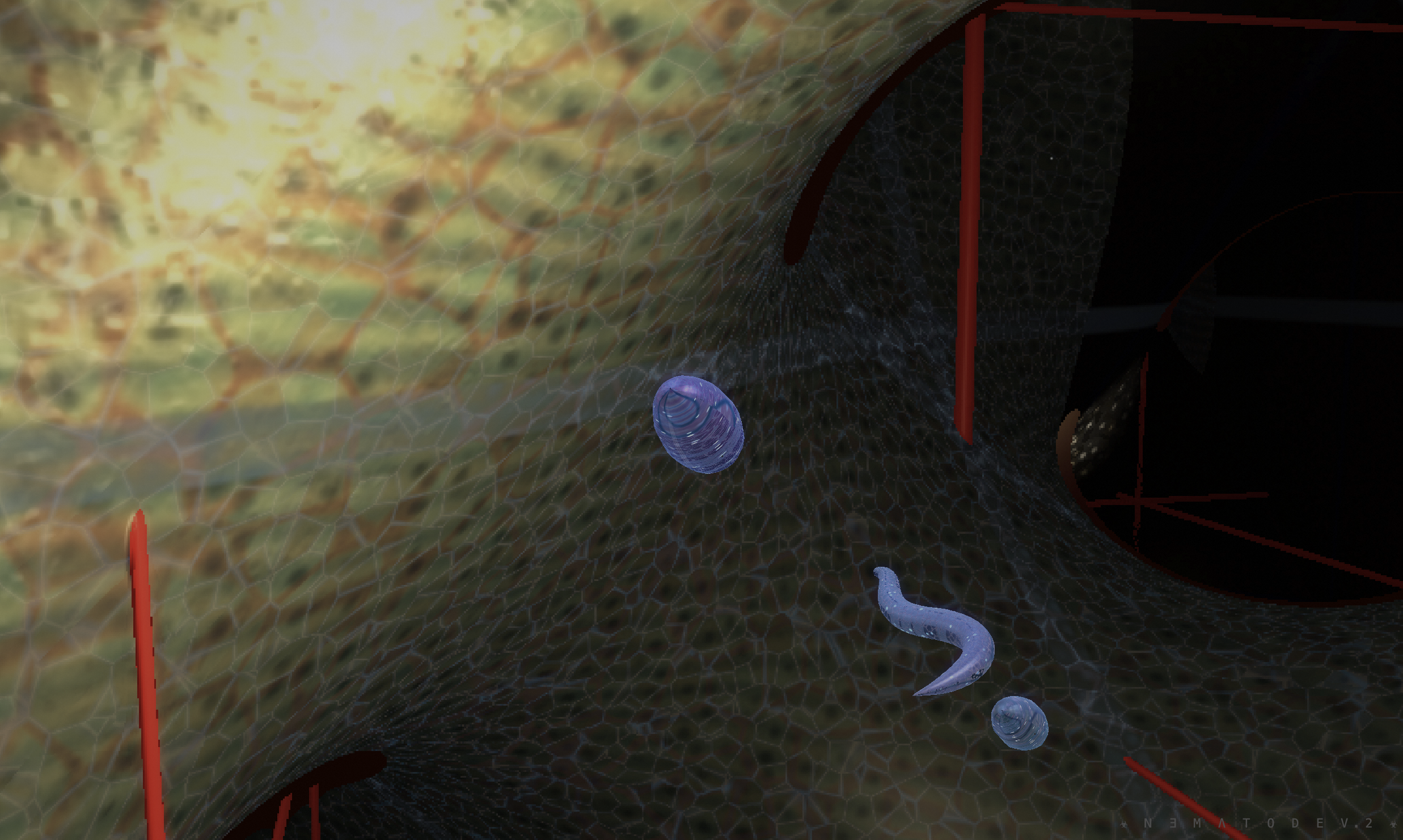
Emergency self-fertilisation becomes available only when there is exactly one living adult, zero eggs and zero infants. The survivor must already have the recorded hermaphrodite role. A male, an unassigned animal or a founder that has never received that role cannot self-fertilise. These remain the simulation’s assigned reproductive roles, rather than an inherited biological-sex system.
The hermaphrodite must be mature, sufficiently fed, past its reproductive recovery interval and below the existing toxin, ecological-load and wound thresholds. It cannot already be paired or carrying a pending cross-clutch. A completed pair’s pending offspring take precedence.
An eligible animal begins the existing five-minute carrying period. At laying, the program checks the lone-hermaphrodite condition again. It can then produce up to eight eggs, limited by its available energy and the shared egg and storage limits. Every egg pays the existing fecundity-dependent energy cost, while the emergency clutch preserves a small maternal reserve. Low reserves can reduce the clutch or prevent laying.
The eggs use the existing ventral carrying, staggered release, gestation, hatching and infant-growth sequence. They receive mutated inheritance from one parent and distinct birth identities. This safeguard does not create replacement adults or grant free energy.
Once any egg or infant exists, another emergency clutch cannot begin. If all offspring are subsequently lost and the same hermaphrodite is again the sole adult, it may qualify again. The parent and its descendants remain exposed to hunger, age and local hazards. A lone male cannot self-fertilise, and a lone hermaphrodite may die before producing viable descendants. Extinction remains possible.
Inheritance
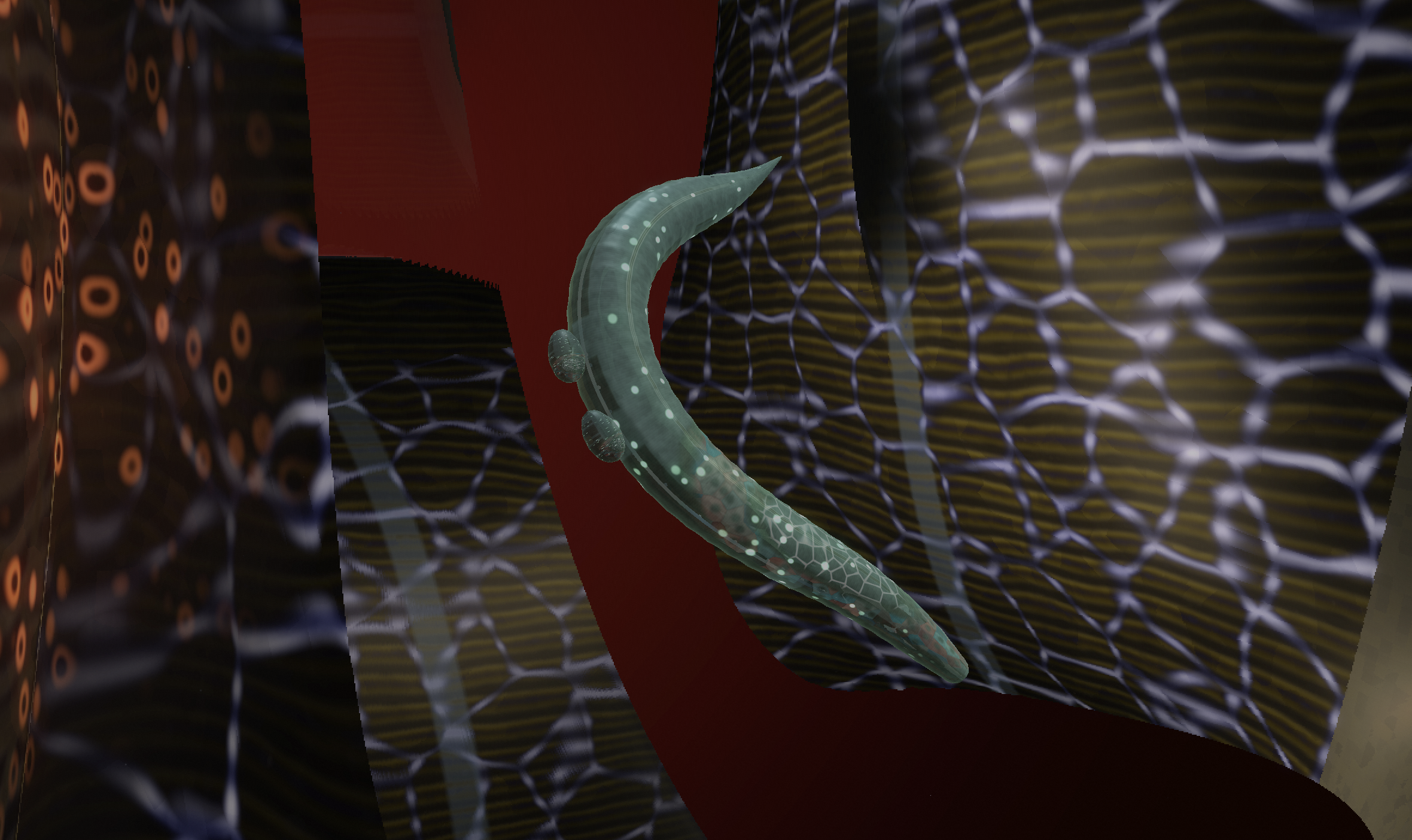
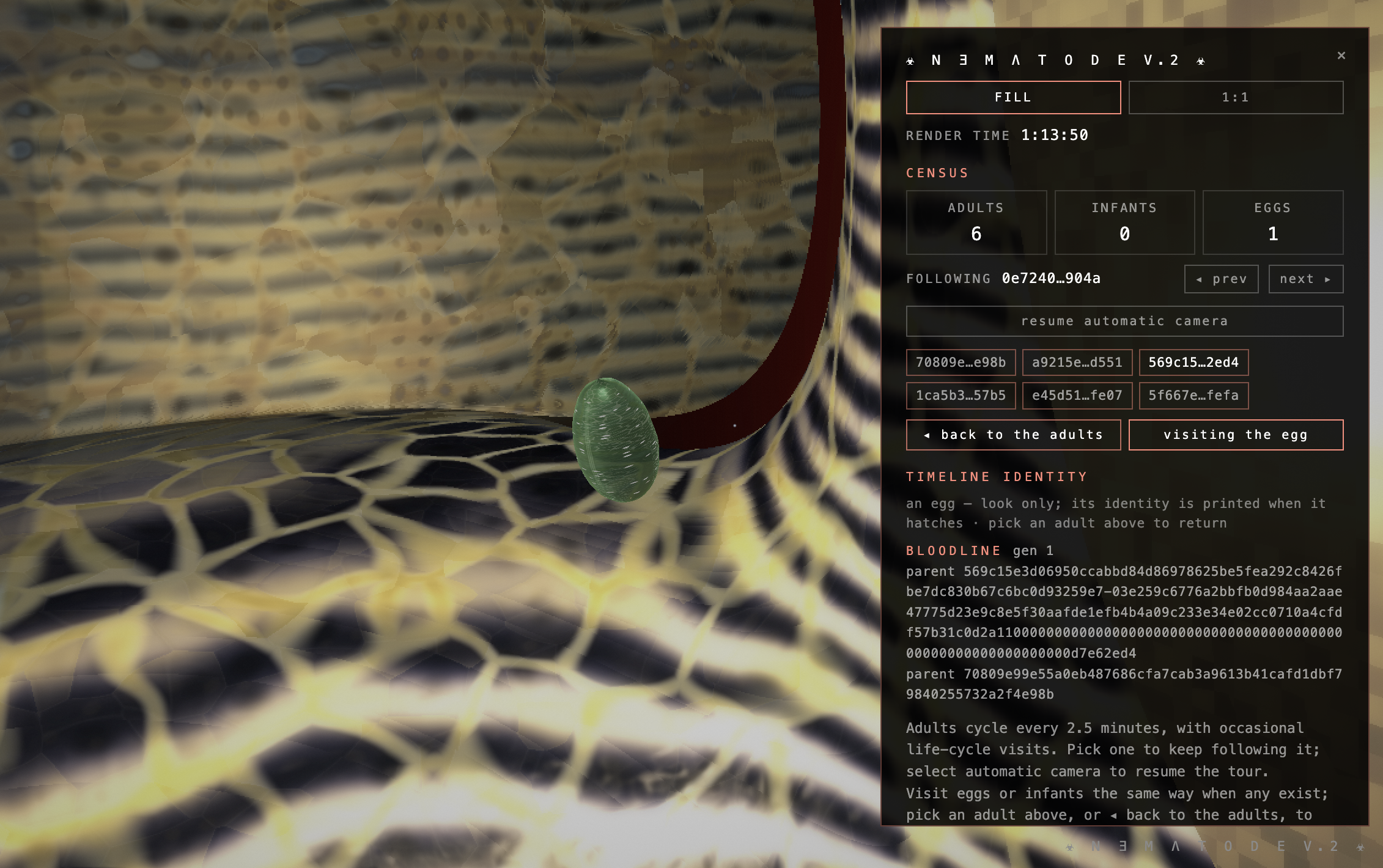
Identity and the parental contribution
Each laid egg already has an identity, although the ordinary card reveals that identity after hatching. Plain timeline seeds are 64 hexadecimal characters. Current packed bloodline identities use a longer base and an ecological extension.
Packed information includes quantised body and diet traits, seven temperaments, parent prefixes, generation, adaptation genes and regulators, policy imprint, inherited places and host marks. The culture’s bloodline book also records known parent identities and assigned reproductive roles. A role such as male is not a fixed sex field in the packed genome.
At laying, the mother contributes current body, diet and ecological information. For a cross-clutch, the father’s body and diet contribution comes from the completed pair’s stored record; his ecological information is refreshed if he is still available. These contributions are blended or recombined, depending on the trait, with mutation. Inherited diet becomes starting expression and constitution.
For an emergency self-clutch, the sole parent supplies those inherited traits. The existing birth mutations still apply, and each egg receives its own identity. Its bloodline records one parent and an incremented generation. The offspring are varied descendants, not adult clones.
Live reproduction also passes a mutated taste preference through the egg, blended between parents for a cross or derived from the sole parent for self-fertilisation. This separate taste prior is not explicitly stored in the identity codec; a seed load reconstructs taste from its seeded prior and encoded constitution. The identity therefore preserves its encoded birth information without being a complete copy of every detail of the live hatchling.
Learning and places
A limited amount of experience crosses the egg. The policy imprint retains 70% of the weighted parental blend, with small mutation; in a self-clutch, the same attenuation applies to the sole parent’s imprint. At most four established valued places are retained, with values reduced to half strength and small positional changes. Ongoing learned place memory remains bounded at 32 cells.
These inherited biases can affect avoidance, feeding and passage-making. Mate-route behaviour uses innate traits and a modest contribution from learned feeding preferences. Successful feeding in cover can leave a weak influence on offspring, while remembered harmful places can discourage a route.
Whole movement tracks, temporary route plans and the detailed navigator’s visit map are not inherited. Offspring receive varied predispositions and faded experience, then learn from their own encounters.
Host-imposed marks
There are also weak marks for bacterial flora, chemical load, wounds and recent anemone-weighted visibility. An established adult life is required to export them. Parental values are capped, blended and attenuated before they are written into the child. In a self-clutch, the sole parent’s values receive the same weakening; self-fertilisation does not strengthen the inherited marks.
Flora, load and wound marks seed small initial ecological states. A flora mark slightly increases bacterial constitution. The visibility mark lowers the initial glow bias and raises coating and matching biases; the other marks have their own effects.
Transient mark values decay exponentially with a ten-minute timescale: after ten minutes, roughly 37% remains. Seeded flora, chemical load and wounds follow their own feeding, detoxification and healing dynamics. The constitution contribution follows the constitution system. These starting conditions remain separate from innate temperament. Energy reserves, current grip, accumulated energy debt and reproductive state are not copied.
Starting another life from an identity
?seed= with a child’s identity starts a new adult life from its packed birth information, within the codec’s precision. It restores the encoded genome and ecological inheritance. It does not resume a previous run, recover later acquired experience or reproduce every future event. The two accompanying founders begin unmarked.
The bloodline book and event history are bounded records, rather than an unlimited archive.
Host response
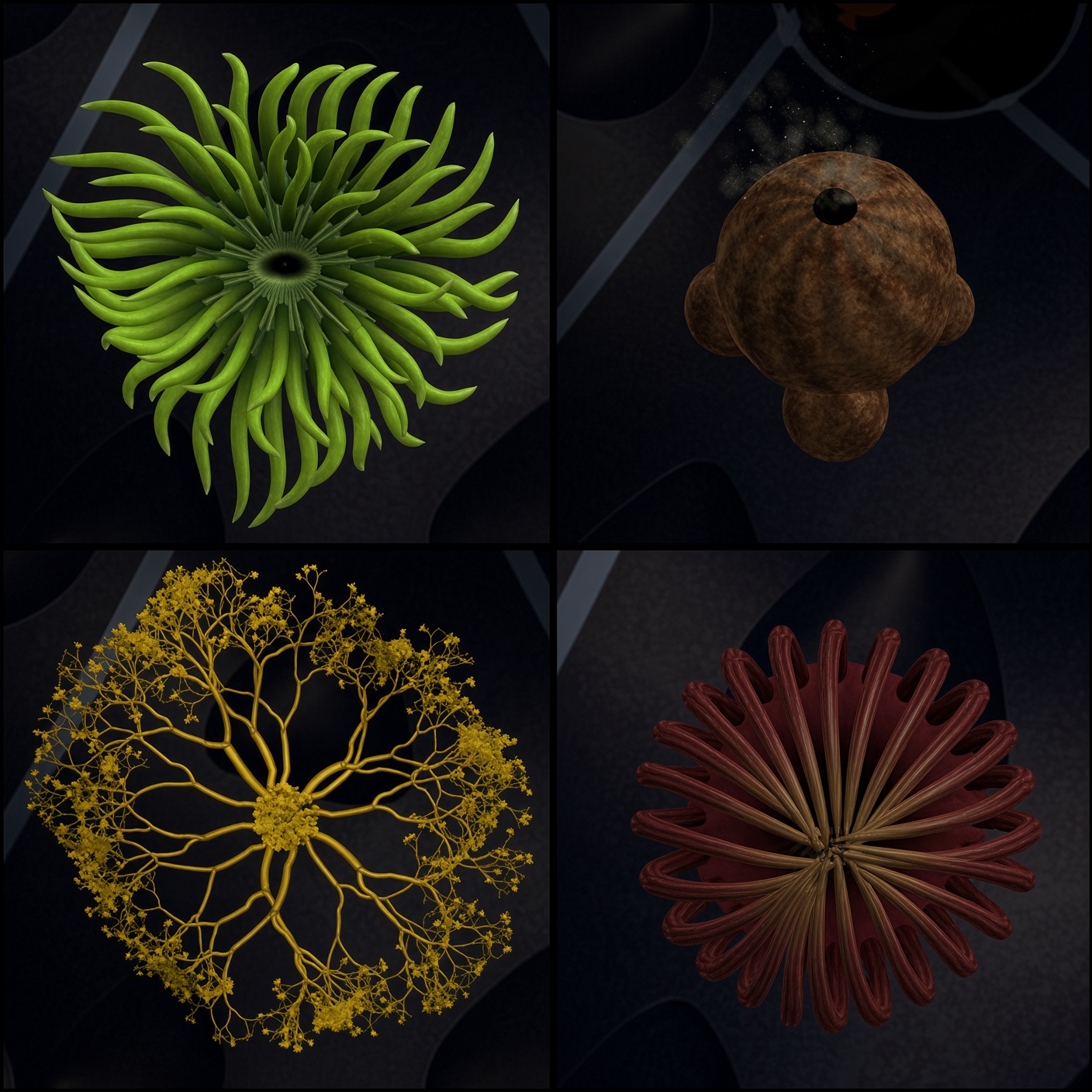
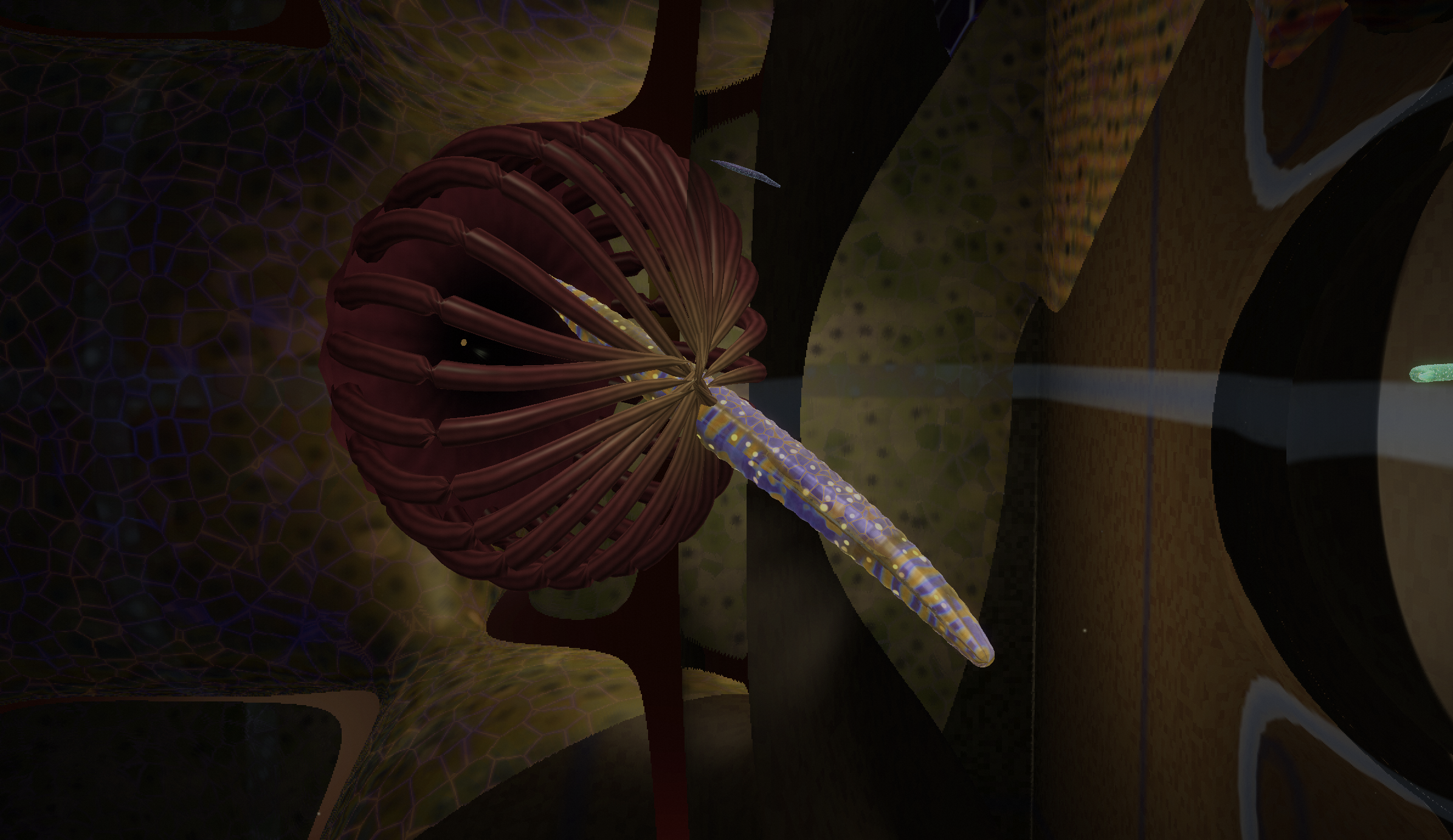
The host’s active population response takes the form of temporary local organs: anemones, spore sites, slime and traps. Placement follows concentrations of worm biomass near suitable surfaces. Their recruitment, strength, reach and potency respond to local density, measured performance pressure and an infection alarm.
Some defences can appear below forty living worms. Reaching forty living adults and infants activates an additional sustained response, independently of whether rendering is slow. Eggs do not count toward that threshold.
At forty, the alarm begins moving toward half of its modelled maximum. Its target then increases with population, reaching the maximum at around one hundred living worms. The alarm builds gradually, and organs take time to appear and strengthen, so the increased attack develops over the following minutes. These alarm values are internal control levels, not percentages of worms selected to die.
Recognition persists after numbers fall. Crossing below forty does not immediately end the response: its strength eases with the smaller population while the host’s infection memory gradually fades. This allows a decline to remain an environmental pressure without holding the host permanently at its strongest setting.
Forty is an activation threshold, not a population cap. One hundred is the point where the alarm target reaches its ceiling, not a prescribed colony size. The colony can continue reproducing under attack and can exceed one hundred. The host maintains at most eight local organ sites at once; that limit applies to its defensive structures.
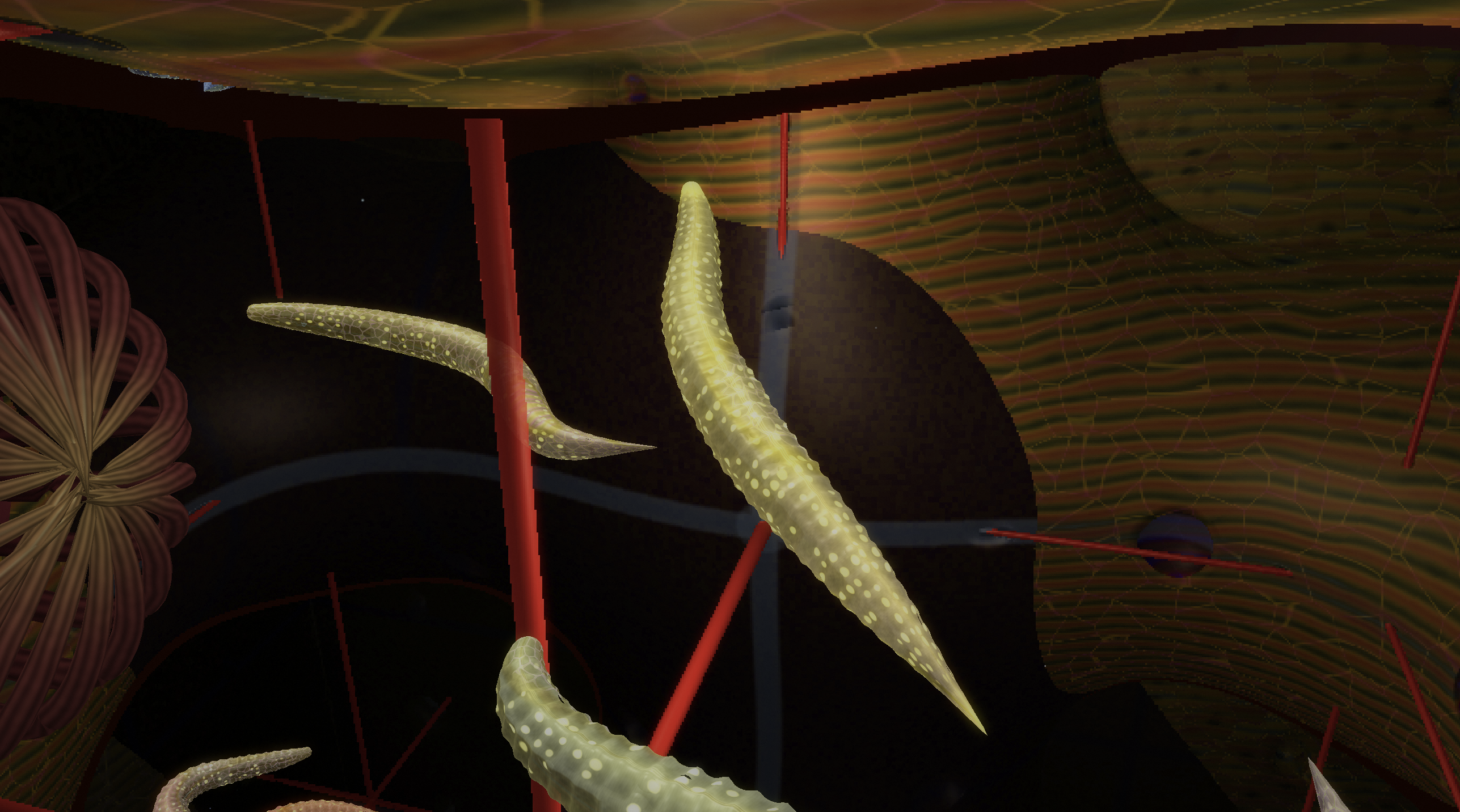
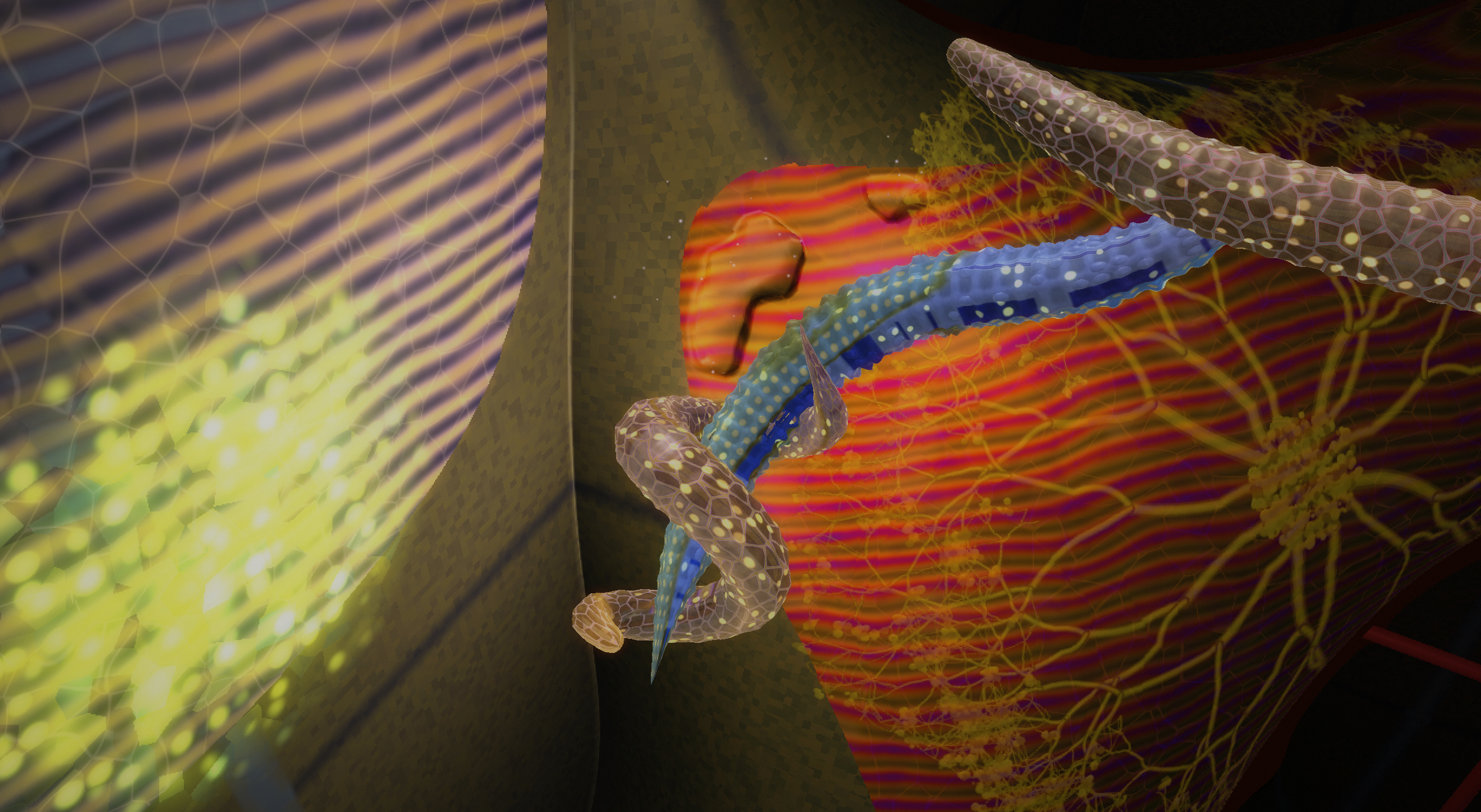
The organs exert different pressures:
Anemones strike locally, with visibility, movement, colour mismatch, glow and defensive traits affecting the encounter.
Spore sites create chemical exposure.
Slime combines chemical exposure with grip.
Traps accumulate grip and can cause wounds while holding a body.
During an alarm, low diet expression, low energy and being stuck amplify an animal’s vulnerability to chemical exposure, anemone attacks and trapping wounds. Mortality is therefore uneven without requiring the host to rank every worm and delete the weakest. Avoidance changes exposure; flora, detoxification, coating and glow change chemical consequences; relief and active escape change the effects of restraint.
The host also keeps modest per-room weights for defence types, updated from changes in nearby biomass. This is a limited adaptive rule: a local decrease may reflect movement as well as death. An organ appearing beside trapped infants is compatible with these rules, but does not establish that the host identified those particular infants as doomed or deliberately chose to remove them.
The active update does not periodically select and delete the weakest animal. The older global immune-thickening mechanism is disabled in normal operation. Population recognition does not itself close pores across the plate or turn most nearby food into poison; the lattice’s ordinary morphing and room-level toxicity continue separately.
Adults and infants can die from sustained energy debt, accumulated local wounds or chemical load, and prolonged toxin disablement. Adults also die when biological age exceeds an individual lifespan threshold. That threshold begins in a 90–150 minute band of biological age, but feeding-supported repair can slow ageing and stress can accelerate it. It is not a fixed wall-clock lifespan.
The stronger response can produce a bottleneck when attacks outpace births and survival. It does not impose a fixed bottleneck size or guarantee that every run will produce visibly divergent lineages. The evolutionary pressure comes from unequal exposure, unequal resistance and unequal reproductive success within the same changing host.
Dead bodies fade; lysis is a shorter disintegration. Neither the last adult nor the animal on the camera is guaranteed protection. Stronger courtship at low population and emergency self-fertilisation provide routes toward recovery, while extinction remains possible.
Pressure
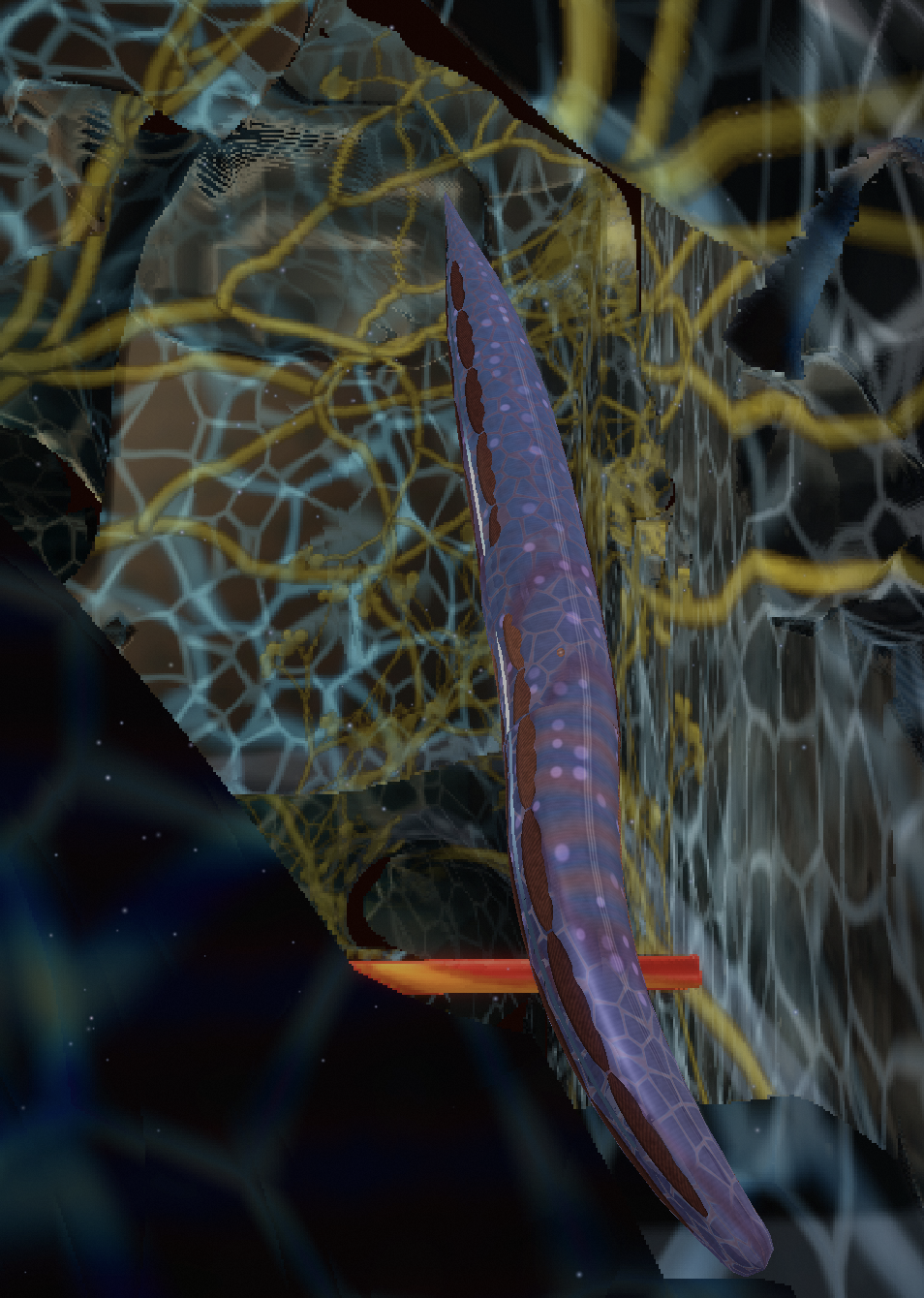
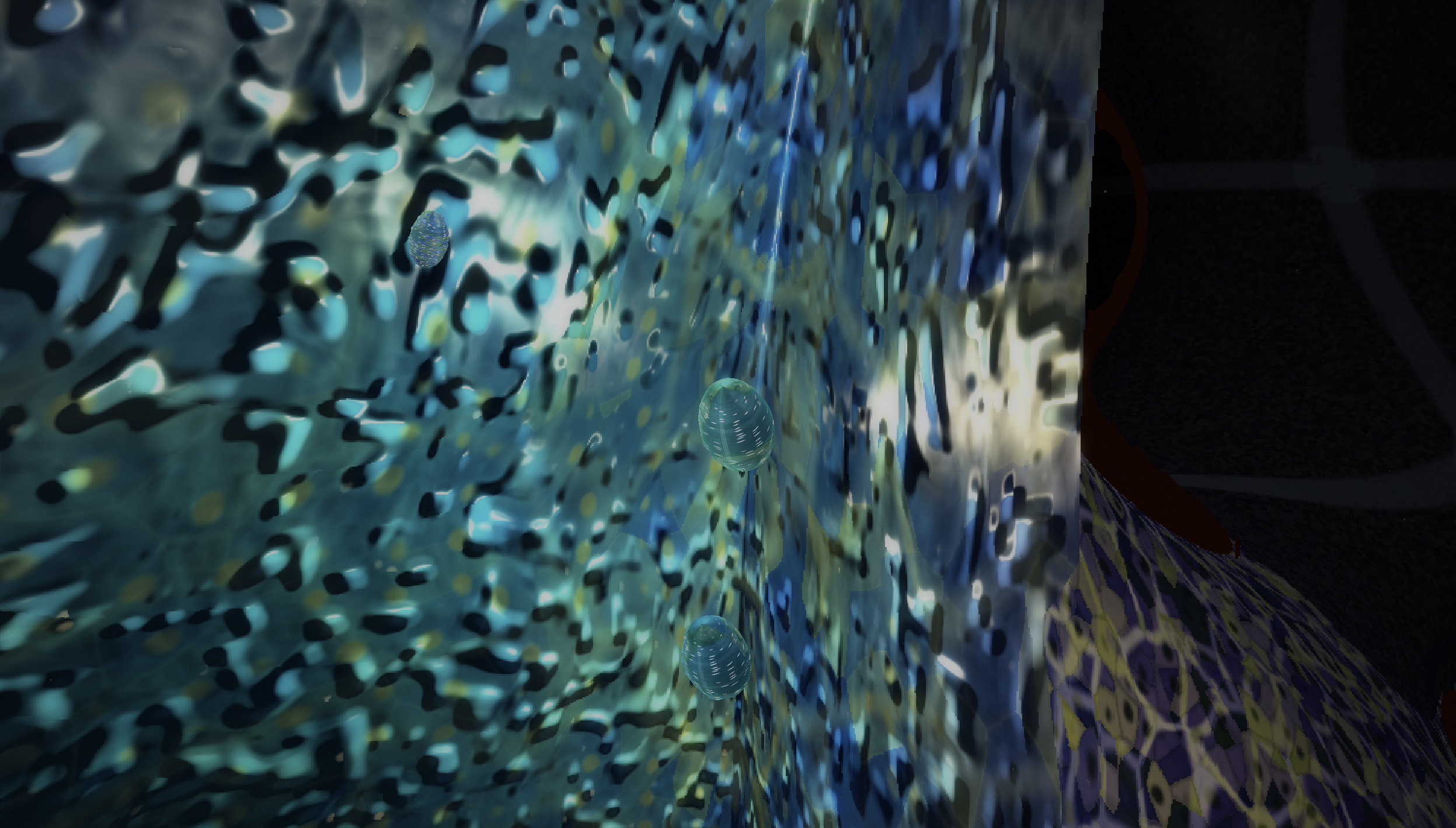
Pressure joins several systems.
Mechanical and spatial
Bodies meet drag, contact, carving and a changing field. Position corrections and unstuck responses exist, but animals can remain held. Passages can close. Pores help connect rooms; edible septa can also be worked through. A pending clutch biases nearby choices without securing a nursery.
Metabolic and reproductive
Gut, energy, toxin, load, wounds and appetite interact. Food and poison can share a bacterial gene. Courtship, passage-making and laying depend on reserves. Protective expression and evasion spend energy that feeding must replace. Stronger mating motivation cannot by itself fund a clutch or open an unchewable barrier. Emergency self-fertilisation removes the need to reach a partner only for an eligible lone hermaphrodite; its eggs still cost energy and its young still need to survive.
Demographic
A population of three or fewer living adults and infants strengthens recovery courtship. Exactly one adult with no eggs or infants opens the separate emergency self-fertilisation route, provided that adult is an eligible recorded hermaphrodite. Reaching forty living adults and infants activates a sustained infection response whose alarm target rises as the population approaches one hundred. Recognition persists and eases after a decline. These thresholds affect behaviour and reproductive opportunity; they are not target populations that the program directly enforces.
Shared storage can grow to 256 slots, including living animals, eggs and uncleared dead bodies. At most eight laid eggs exist at once. These technical limits remain distinct from the host’s ecological response.
Computational and temporal
A governor adjusts rendering cost. A separate estimate of frame time and simulation cost feeds local host pressure. That estimate does not measure a GPU’s biological carrying capacity. Better hardware may ease the performance-related component; local density and infection recognition still apply.
Simulation advances through executed steps and can discard time it cannot process. The visible render counter is recorded separately. An overnight wall-clock span therefore does not guarantee the same amount of simulated life on every browser or machine.
Evolution
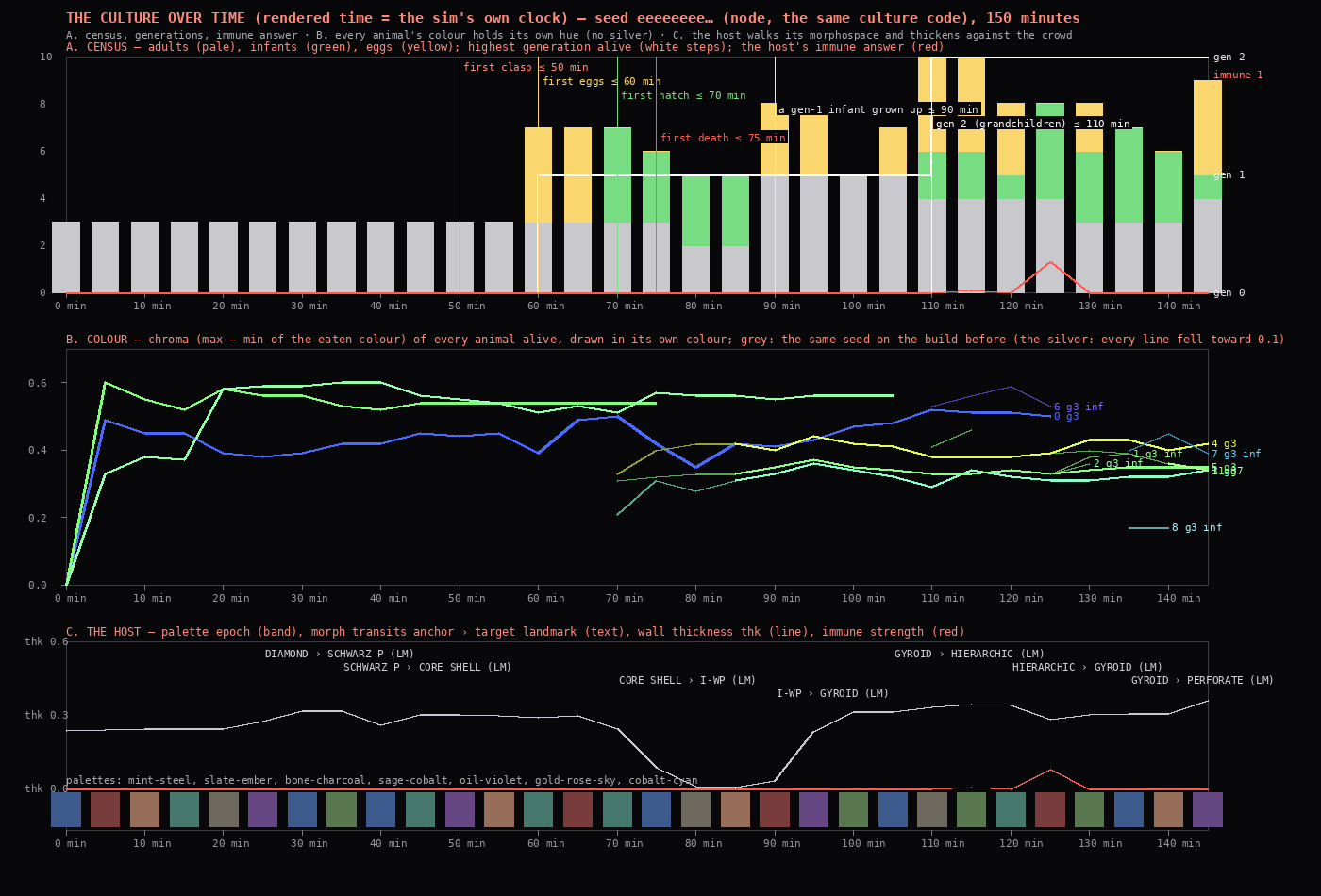
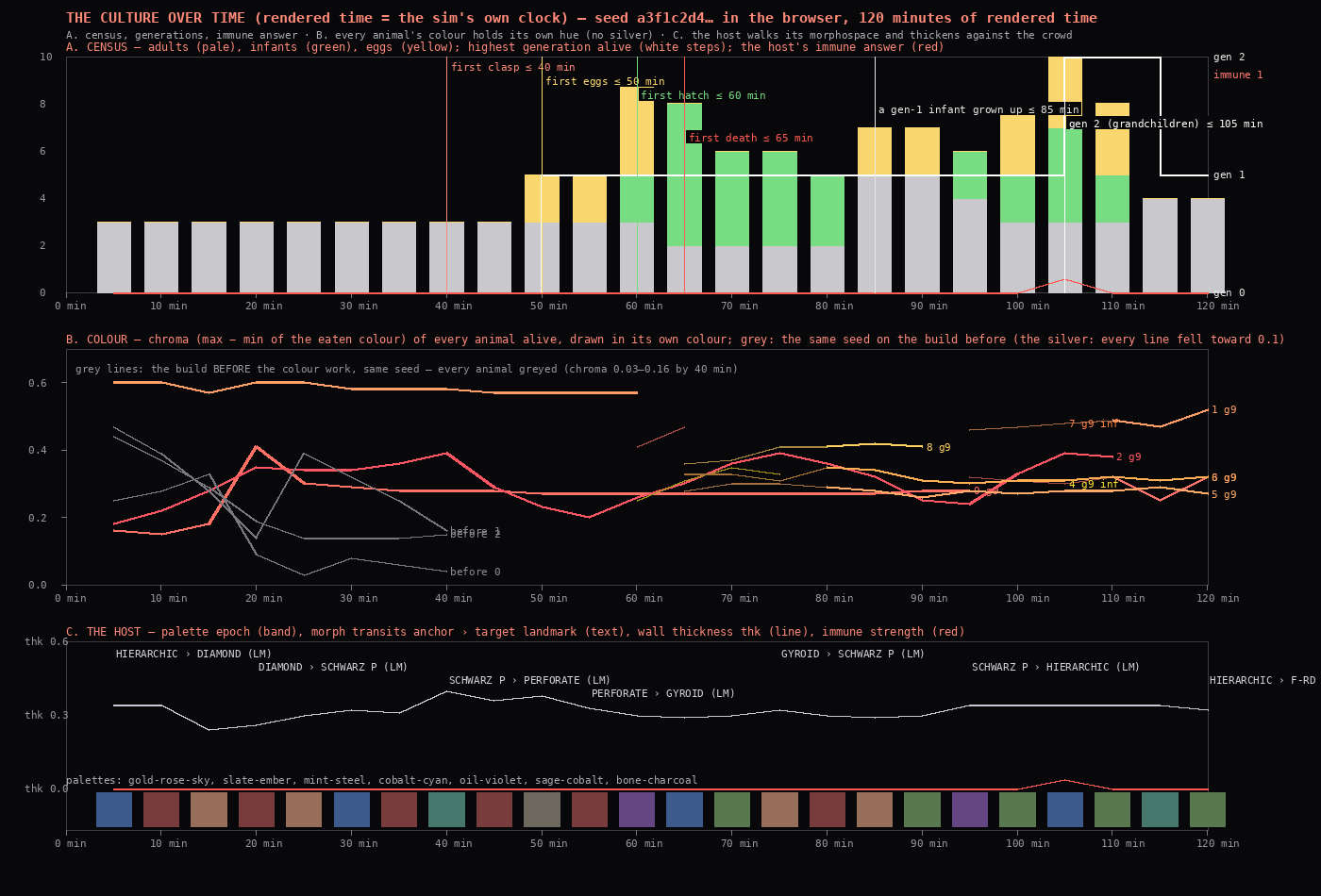
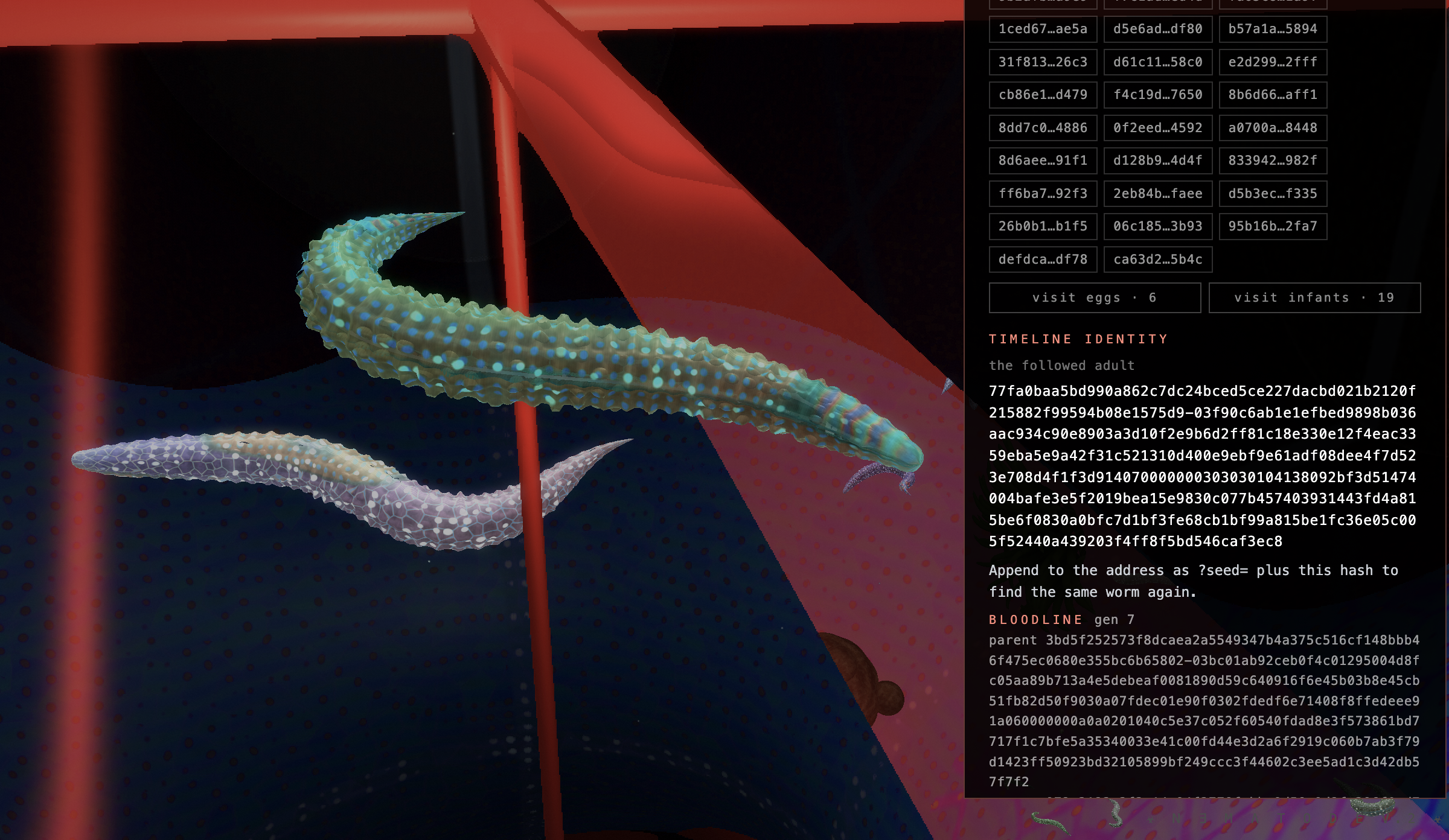
The work supports variation, inheritance, and differential survival and reproduction. These mechanisms can change the distribution of traits across generations. They do not guarantee that every generation improves, that a stable population persists or that visibly distinct clades always appear.
Within a life, an animal develops through feeding, reversible expression, injury and learning. Across lives, inherited differences meet the host again. An animal that feeds effectively, sustains the effort of a passage and completes a clasp may leave descendants where a less successful seeker leaves none. Its offspring inherit a varied share of the relevant constitution, innate traits and weak learned biases, then face their own conditions.
Different host encounters can favour different combinations. Chemical resistance can benefit a glowing, flora-supported body, while anemones may favour a less conspicuous one. Physical escape, continued feeding and access to mates can change either outcome. Persistence alone does not ensure descendants.
The recovery response favours renewed reproduction when the colony is sparse. At its most depleted, an eligible lone hermaphrodite may continue the line through a self-clutch, carrying one parent’s varied inheritance forward. This makes continuity more likely without guaranteeing recovery. The host’s infection response increases resistance when the colony becomes crowded and remains sensitised after numbers fall. Outcomes emerge from the implemented rules of movement, feeding, reproductive eligibility, inheritance and death.
NEMATODE V.2 asks what happens when a body can metabolise its mathematical surroundings, pass a changed beginning to its descendants, and encounter an environment that intensifies its resistance as the infection grows.
☣ SETHIX 2026 ☣